










Đề bài

Fill in each numbered blank with one suitable word or phrase.

One of the first novels in the history of literature (1) ______ written in England in 1719. It was Robinson Crusoe by Daniel Defoe. Daniel Defoe was born (2) _____ London in the family of a rich man. When Daniel was a schoolboy, he began to write stories. After (3)_______ school, he worked in his father’s shop and (4)______ articles for newspapers. Defoe visited many countries and met many people. That helped him (5) ______ in his writings. In 1719, when Defoe was sixty years old, he wrote the novel Robinson Crusoe which (6) _______ him famous. Defoe used in his book a true story about a sailor who (7) ______ on an island for four years. Robinson Crusoe in Defoe's novel lived on an island for twenty-eight years. People liked (8) _____ novel in England and in many other countries, Daniel Defoe wrote other books. (9) ____, his novel Robinson Crusoe was the (10) _______ famous. Defoe was not a rich man when he died in 1731.

Câu 1

One of the first novels in the history of literature (1) ______ written in England in 1719.  

    A.

    has  

    B.

    have

    C.

    was

    D.

    were

Đáp án : C

Phương pháp giải

Câu bị động ở thì quá khứ đơn với chủ ngữ số ít nên từ cần điền phải là động từ to be: was

Lời giải của GV Loigiaihay.com

Câu bị động ở thì quá khứ đơn với chủ ngữ số ít nên từ cần điền phải là động từ to be: was

=> One of the first novels in the history of literature was written in England in 1719. 

Tạm dịch: Một trong những tiểu thuyết đầu tiên trong lịch sử văn học được viết ở Anh vào năm 1719.


Xem thêm các câu hỏi cùng đoạn
Câu 2

It was Robinson Crusoe by Daniel Defoe. Daniel Defoe was born (2) _____ London in the family of a rich man.

    A.

    in 

    B.

    at

    C.

    on

    D.

    from

Đáp án : A

Phương pháp giải

Giới từ: in + địa danh, địa điểm cụ thể

Lời giải của GV Loigiaihay.com

was born in London: sinh ra ở London

=> It was Robinson Crusoe by Daniel Defoe. Daniel Defoe was born in London in the family of a rich man.

Tạm dịch: Đó là Robinson Crusoe của Daniel Defoe. Daniel Defoe sinh ra ở London trong gia đình của một người đàn ông giàu có.


Câu 3

When Daniel was a schoolboy, he began to write stories. After (3)_______ school, he worked in his father’s shop ...

    A.

    coming  

    B.

    going

    C.

    staying

    D.

    leaving

Đáp án : D

Phương pháp giải

come (v): đến

go (v): đi

stay (v): ở

leave (v): rời khỏi


Lời giải của GV Loigiaihay.com

come (v): đến

go (v): đi

stay (v): ở

leave (v): rời khỏi

=> When Daniel was a schoolboy, he began to write stories. After leaving school, he worked in his father’s shop ...

Tạm dịch: Khi Daniel còn là một cậu học sinh, anh bắt đầu viết truyện. Sau khi rời trường, anh làm việc trong cửa hàng của cha mình ...


Câu 4

After leaving school, he worked in his father’s shop and (4)______ articles for newspapers.

    A.

    sold

    B.

    wrote

    C.

    bought

    D.

    read

Đáp án : B

Phương pháp giải

sell (v): bán

write (v): viết

buy (v): mua

read (v): đọc

Lời giải của GV Loigiaihay.com

sell (v): bán

write (v): viết

buy (v): mua

read (v): đọc

=> After leaving school, he worked in his father’s shop and wrote articles for newspapers.

Tạm dịch: Sau khi rời trường, anh làm việc trong cửa hàng của cha mình và viết bài cho các tờ báo.


Câu 5

Defoe visited many countries and met many people. That helped him (5) ______ in his writings.

    A.

    few

    B.

    much

    C.

    plenty

    D.

    many 

Đáp án : B

Phương pháp giải

- help (v): giúp đỡ và sau đó không có danh từ nên chọn much: nhiều (đi với danh từ không đếm được)

Lời giải của GV Loigiaihay.com

few: một vài

much: nhiều (đi với danh từ không đếm được)

plenty: dồi dào, có nhiều

many: nhiều (đi với danh từ đếm được số nhiều)

Sự giúp đỡ không đếm được => ta dùng much

=> Defoe visited many countries and met many people. That helped him much in his writings.

Tạm dịch: Defoe đã đến thăm nhiều quốc gia và gặp gỡ nhiều người. Điều đó đã giúp anh ta nhiều trong các tác phẩm của mình.


Câu 6

In 1719, when Defoe was sixty years old, he wrote the novel Robinson Crusoe which (6) _______ him famous.

    A.

    made

    B.

    did

    C.

    brought

    D.

    let

Đáp án : A

Phương pháp giải

make sb famous: làm cho ai trở nên nổi tiếng

Lời giải của GV Loigiaihay.com

make sb famous: làm cho ai trở nên nổi tiếng

=> In 1719, when Defoe was sixty years old, he wrote the novel Robinson Crusoe which made him famous.

Tạm dịch: Năm 1719, khi Defoe sáu mươi tuổi, ông đã viết cuốn tiểu thuyết Robinson Crusoe khiến ông trở nên nổi tiếng.


Câu 7

Defoe used in his book a true story about a sailor who (7) ______ on an island for four years.

    A.

    visited

    B.

    came

    C.

    went

    D.

    lived

Đáp án : D

Phương pháp giải

visit (v): thăm

come (v): đến

go (v): đi

live (v): sống

Lời giải của GV Loigiaihay.com

visit (v): thăm

come (v): đến

go (v): đi

live (v): sống

=> Defoe used in his book a true story about a sailor who lived on an island for four years.

Tạm dịch: Defoe sử dụng trong cuốn sách của mình một câu chuyện có thật về một thủy thủ sống trên một hòn đảo trong bốn năm.


Câu 8

People liked (8) _____ novel in England and in many other countries, Daniel Defoe wrote other books.

    A.

    a

    B.

    an

    C.

    the

    D.

    x

Đáp án : C

Phương pháp giải

“novel” là danh từ đã được xác định cụ thể ở trong bài và đã được đề cập trước đó  

Lời giải của GV Loigiaihay.com

“novel” là danh từ đã được xác định cụ thể ở trong bài và đã được đề cập trước đó nên ta dùng mạo từ “the”

=> People liked the novel in England and in many other countries, Daniel Defoe wrote other books.

Tạm dịch: Mọi người thích tiểu thuyết ở Anh và ở nhiều nước khác, Daniel Defoe đã viết những cuốn sách khác.


Câu 9

People liked the novel in England and in many other countries, Daniel Defoe wrote other books. (9) ____,  his novel Robinson Crusoe was the (10) _______ famous.

    A.

    And

    B.

    Because

    C.

    So

    D.

    However 

Đáp án : D

Phương pháp giải

and: và

because: bởi vì

so: vì vậy

however: tuy nhiên

Lời giải của GV Loigiaihay.com

and: và

because: bởi vì

so: vì vậy

however: tuy nhiên

- Vế trước có đề cập: viết rất nhiều cuốn sách. Vế sau có nói cuốn tiểu thuyết nổi tiếng nhất là...

Vậy thì chọn however để biểu thị sự đối lập hoặc để nhấn mạnh 1 cái gì đó.

=> People liked the novel in England and in many other countries, Daniel Defoe wrote other books. However,  his novel Robinson Crusoe…

Tạm dịch: Mọi người thích tiểu thuyết ở Anh và ở nhiều nước khác, Daniel Defoe đã viết những cuốn sách khác. Tuy nhiên, tiểu thuyết Robinson Crusoe của ông ấy


Câu 10

However, his novel Robinson Crusoe was the (10) _______ famous. Defoe was not a rich man when he died in 1731.

    A.

    very

    B.

    much

    C.

    most

    D.

    best

Đáp án : C

Phương pháp giải

Cấu trúc câu so sánh hơn nhất với tính từ dài: S + V + the + most + adj/adv…

Lời giải của GV Loigiaihay.com

Cấu trúc câu so sánh hơn nhất với tính từ dài: S + V + the + most + adj/adv…

=> However, his novel Robinson Crusoe was the most famous. Defoe was not a rich man when he died in 1731.

Tạm dịch: Tuy nhiên, cuốn tiểu thuyết Robinson Crusoe của ông là nổi tiếng nhất. Defoe không phải là một người đàn ông giàu có khi ông qua đời vào năm 1731.

Tạm dịch bài:

Một trong những tiểu thuyết đầu tiên trong lịch sử văn học được viết ở Anh vào năm 1719. Đó là Robinson Crusoe của Daniel Defoe. Daniel Defoe sinh ra ở London trong gia đình của một người đàn ông giàu có. Khi Daniel còn là một cậu học sinh, anh bắt đầu viết truyện. Sau khi rời trường, anh làm việc trong cửa hàng của cha mình và viết bài cho các tờ báo. Defoe đã đến thăm nhiều quốc gia và gặp gỡ nhiều người. Điều đó đã giúp anh ta nhiều trong các tác phẩm của mình. Năm 1719, khi Defoe sáu mươi tuổi, ông đã viết cuốn tiểu thuyết Robinson Crusoe khiến ông trở nên nổi tiếng. Defoe sử dụng trong cuốn sách của mình một câu chuyện có thật về một thủy thủ sống trên một hòn đảo trong bốn năm. Mọi người thích tiểu thuyết ở Anh và ở nhiều nước khác, Daniel Defoe đã viết những cuốn sách khác. Mọi người thích tiểu thuyết ở Anh và ở nhiều nước khác, Daniel Defoe đã viết những cuốn sách khác. Tuy nhiên, cuốn tiểu thuyết Robinson Crusoe của ông là nổi tiếng nhất. Defoe không phải là một người đàn ông giàu có khi ông qua đời vào năm 1731.



Các bài tập cùng chuyên đề

Bài 1 :

Rewrite the sentences so that it has similar meaning as the sentences printed before, using the word(s) given.

Xem lời giải >>

Bài 2 :

Choose the best option to complete the following sentence.

Xem lời giải >>

Bài 3 :

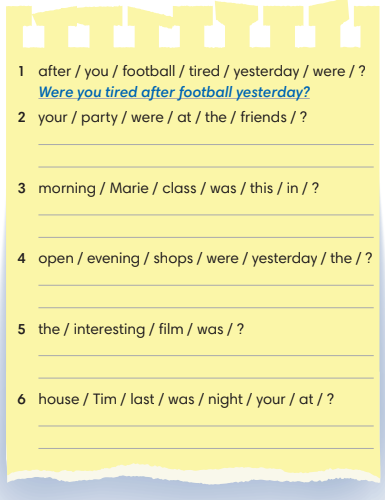
1. Complete the sentences with was, were, wasn’t and weren’t. Then check your answers in the text on page 36.

(Hoàn thành các câu với was, were, wasn’t và weren’t. Sau đó, kiểm tra câu trả lời của bạn trong phần văn bản ở trang 36.)

1 Last week I ………… with my friends inthe History Museum of Hồ Chí Minh City.

2 The clothes ………… comfortable at all.

3 The school trip to the Natural History Museum ………… boring.

4 The exhibits ………… really interesting.

5………… Bluebird strange? Yes, it ………… very big and long.

Xem lời giải >>

Bài 4 :

 2. Look at the sentences in exercise 1. Then complete the Rules using the correct form of was and were. 

(Nhìn vào các câu trong bài tập 1. Sau đó, hoàn thành các Quy tắc bằng cách sử dụng dạng đúng của was và were.)

RULES

1 In affirmative sentences, we use was or ……………. .

2 In negative sentences, we use ……………. .or weren’t.

3 In yes / no questions, we use ……………. ./ were + subject + phrase.

4 In short answers, we use yes / no + pronoun +……………. . / wasn’t or were / weren’t.

Xem lời giải >>

Bài 5 :

 3. Complete the sentences with was, were, wasn’t and weren’t.

(Hoàn thành các câu với was, were, wasn’t và weren’t.)

Mai and her friends were in the History Museum of Hồ Chí Minh City last week. ✓

1 The clothing exhibition ……….. boring. ✗

2 Bluebird ……….. a motorbike. ✗

3 The Nguyễn Dynasty ……….. from 1802to 1945. ✓

4 ……….. the Natural History Museuminteresting? Yes, it………..   . ✓

5 ……….. the dinosaurs unpopular? No, they………..   . ✗

Xem lời giải >>

Bài 6 :

4. Write questions and short answers for the sentences in exercise 3.

(Viết câu hỏi và câu trả lời ngắn gọn cho các câu trong bài tập 3.)

Were Mai and her friends in the History Museum of Hô Chí Minh City last week?

(Mai và những người bạn của cô ấy có ở Bảo tàng Lịch sử Thành phố Hồ Chí Minh tuần trước không?)

Yes, they were.

(Có.)

Xem lời giải >>

Bài 7 :

5. Choose the correct words.

(Chọn từ đúng.)

1 There was / were a car from 1964.

2 There was / were lots and lots of cars.

3 There wasn’t / weren’t a good café.

4 There wasn’t / weren’t any exciting animals.

Xem lời giải >>

Bài 8 :

6. Write sentences about an event in your town / city last year. Use There was and There were.

Think about:

(Viết câu về một sự kiện ở thị trấn / thành phố của bạn vào năm ngoái. Sử dụng There wasvà There were.

Nghĩ về: )

the place            the date            the number of people            music             famous poeple

It was in the town centre. It was in May last year ...

(Nó ở trung tâm thị trấn. Đó là vào tháng Năm năm ngoái ...)

Xem lời giải >>

Bài 9 :

7. USE IT! Write questions with was and were and the words in the box. Then ask and answer the questions with your partner.

(THỰC HÀNH! Viết câu hỏi với was và were và các từ vào ô trống. Sau đó hỏi và trả lời các câu hỏi với bạn của bạn.)

1 ……………. you at 8 o’clock this morning?

2 ……………. your first teacher?

3 ……………. Lê Quý Đôn?

4 ……………. your last English test?

5……………. your first visit to a museum?

6……………. the last SEA Games?

Where were you at8 o’clock this morning?

(Bạn đã ở đâu lúc 8 giờ sáng nay?)

I was on the bus. 

(Tôi đã ở trên xe buýt.)

Xem lời giải >>

Bài 10 :

Finished? Write quiz questions about the museum on the website you know.

(Bạn đã hoàn thành? Viết các câu hỏi đố vui về bảo tàng trên trang web mà bạn biết.)

Xem lời giải >>

Bài 11 :

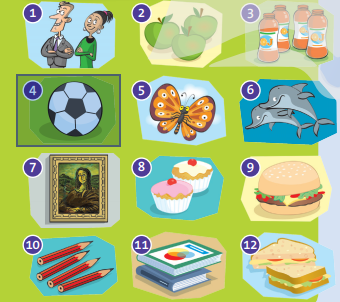
2.MEMORY GAME. Work in groups. Follow the instructions.

(TRÒ CHƠI GHI NHỚ. Làm việc nhóm. Làm theo chỉ dẫn.)

-Look at the pictures for 20 seconds. Close your books.

-Take it in turns to say what objects there were, using There was / There were.

There was a football. There were twoo books.

-The winner is the last player who can remember something.


Xem lời giải >>

Bài 12 :

3. Write sentences using the affirmative (✔), negative (✘) or question (?) form of was or were.

(Viết các câu sử dụng dạng khẳng định (✔), phủ định (✘) hoặc câu hỏi (?) Của was hoặc were.)

1 the tour / very interesting ✔

2 the tunnels / really old ✔

3 what / the name of the tour ?

4 the visit to the old town / very long ✘

5 the tour guide / good ?

6 our teacher / with us on the trip ✔

7 the tourists / scared of the dark ✘

8 your friends / at the museum too ?

Xem lời giải >>

Bài 13 :

2. Find more examples of was / were in the dialogue in Exercise 1.

(Tìm thêm ví dụ về was / were trong đoạn hội thoại ở Bài tập 1.)

Grammar (Ngữ pháp)

PastSimple: was / were (Quá khứ đơn)

-

was out. (Tôi đã ở ngoài.)

We were at the zoo. (Chúng tôi đã ở sở thú.)

?

I wasn’t at the shops. (Tôi không có ở cửa hàng.)

We weren’t at home. (Chúng tôi không ở nhà.)


Were you at home? (Bạn có ở nhà không?)

Was it boring? (Nó có nhàm chán không?)

Were you happy? (Bạn có hạnh phúc không?)

Where were they? (Họ đã ở đâu?)

Yes, I was. / No, I wasn’t. (Đúng, tôi có / Không, tôi không.)

Yes, it was. / No, it wasn’t. (Đúng. / Không, không phải vậy.)

Yes, we were. / No, we weren’t.(Vâng, là chúng tôi. / Không, chúng tôi đã không.)

there is (isn’t) => there was (wasn’t) (có (không phải) => đã có (đã không))

there are (aren’t) => there were (weren’t) (có (không phải) => đã có (đã không))

Time expressions: last night, last weekend, yesterday, this morning, two days ago, at ten o’clock (Biểu thức thời gian: đêm qua, cuối tuần trước, hôm qua, sáng nay, hai ngày trước, lúc mười giờ)

Xem lời giải >>

Bài 14 :

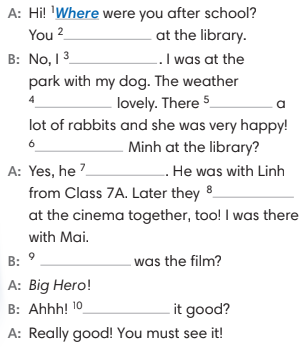
3. Complete the dialogue with was, were, wasn’t or weren’t. Listen and check.

(Hoàn thành cuộc đối thoại với đã, đã, không hoặc không. Nghe và kiểm tra.)

Kyle: Where (1)____ you yesterday, Zaddie?

Zadie: I (2)____ with Madge. We (3)____ at the shops.

Kyle: (4)____ you at the shops in the centre?

Zadie: Yes, we (5)____.

Kyle: (6)____ it busy?

Zadie: No, it (7)____. There (8)____ any people there because the shops (9)____ closed. It (10)____ a public holiday. There (11)____ only one shop open, a newsagent’s!

Xem lời giải >>

Bài 15 :

4. Use the words below to make sentences about the cartoon. Use there was / were.

(Sử dụng các từ dưới đây để đặt câu về phim hoạt hình. Sử dụng there was / were.)

chimps (tinh tinh)

not many people (không nhiều người)

old lion (sư tử già)

giraffe (hươu cao cổ)

not any bears (không phải bất kỳ con gấu nào)

monkeys (những con khỉ)

penguins (những con chim cánh cụt)

gift shop (cửa hàng quà tặng)

Xem lời giải >>

Bài 16 :

3. Complete the sentences with was, wasn’t, were or weren’t.

(Hoàn thành các câu với was, wasn’t, were hoặc aren’t.)

Dolly the sheep

+ Why (1) _____ Dolly famous?

+ She (2) _____ the first animal clone in the world.

+ (3) _____ Dolly from England?

+ No, she (4) _____ . She (5) _____ Scottish, from the Roslin Institute near Edinburgh.

+ (6) _____ there any other clones at that institute?

+ Yes, there (7) _____, but Dolly (8) _____ the first one.

Xem lời giải >>

Bài 17 :

1.Complete the table with was, were, wasn’t or weren’t. 

(Hoàn thành bảng sau với was, were, wasn’t or weren’t.)

Affirmative

I/He/She/It

You/We/They

was

1             

very brave.

Negative

I/He/She/It

You/We/They

2           

3           

scared.

Questions

4              

5              

the king cruel?

they rich?

Who

6               

interserted in the museum?

Where

7                 

you last night?

Short answers

Affirmative

Yes, I/he/she/it

8               

Yes, you/we/they


9             

Negative

No, I/he/she/it

10              

No, you/we/they

11                   

Xem lời giải >>

Bài 18 :

2.Complete the questions with what, where or who, and was or were. Then choose the correct answer.

(Hoàn thành các câu hỏi với what, where who, was và were. Sau đó chọn câu trả lời đúng.)

1 Where were the artists Michelangelo and Raphael from?

a Spain                               b France                                c Italy

2 the name of Shakespeare’s play about a young man and a young woman?

a Romeo and Juliet                      b Hamlet               c King Lear

3 the first president of the United States?

a George Washington                  b Abraham Lincoln                c John F.Kennedy

4 the first Olympic games competition?

a Rome                    b Cairo                   c Olympia

Xem lời giải >>

Bài 19 :

3.Complete the sentences with was, wasn’t, were or weren’t.

(Hoàn thành các câu sau với was, wasn’t, were hoặc weren’t.)

The tunnels under the city were dark and dangerous places in the 18th century.

(Các đường hầm dưới thành phố là những nơi tối tăm và nguy hiểm vào thế kỷ 18.)

1 Cara at the concert last Friday because she ill.

2 Weinterested in that long, boring story. It very exciting.

3 Who your guide at the museum?

4 The visitors  happy with coffee in the café. Itcold and expensive!

5 The weather is good today, but yesterday it really bad.

6 ‘  you brave on the tour of the tunnels?’ ‘No, we !’

Xem lời giải >>

Bài 20 :

5.Imagine you went on a school trip. Write sentences about the trip with there was and there were. Use the words to help you.

(Hãy tưởng tượng bạn đã tham gia một chuyến đi của trường. Viết các câu về chuyến đi với there was and there. Sử dụng các từ để giúp bạn.)

Xem lời giải >>

Bài 21 :

1.Complete the tables with the words.

(Hoàn thành bảng sau với các từ cho sẵn.)

reading         was             was           Was         Was             wasn’t             wasn’t          were       Were weren’t 

Questions

(What)

Was 

1              

2             

I

he/she/it

you/we/they

3             in class?

Short answers

Affirmative

Yes, I 4              

Yes, he/she/it 5               

Yes, /you/we/they 6                  

Negative

No, I  7             

No, he/she/it 8              

No, /you/we/they 9              

Xem lời giải >>

Bài 22 :

1. Complete the sentences with was, wasn’t, were and weren’t.

(Hoàn thành câu với was, wasn’t, were và weren’t.)

1. I wasn’t at school last week because I ___ on holiday with my parents.

2. We ___ in Spain, on the south coast.

3. We ___ in a very expensive hotel because dad wanted a cheap holiday! But it ___ nice and there ___ a lot of teenagers there – cool for me!

4. Our hotel! ___ on the beach and I ___ in the water every day!

5. It ___ very hot, but the sea ___ quite warm and good for swimming.

6. There ___ an aquarium near the hotel and there ___ some interesting fish! There ___ any sharks or dolphins – just small fish.

Xem lời giải >>

Bài 23 :

2. Order the words to make questions.

(Sắp xếp các từ để tạo thành câu hỏi.)

Xem lời giải >>

Bài 24 :

3. Read the sentences and make questions about the underlined words.

(Đọc các câu và đặt câu hỏi về những từ gạch chân.)

1. We were in Sapa last week.

When were you in Sapa?

2. They were in the park at lunchtime.

_______?

3. I was with Mai Anh after school.

_______?

4. The weather was hot in Hồ Chí Minh City.

_______?

5. The film was on TV at 7.30.

_______?

6. Minh was on the phone.

______?

Xem lời giải >>

Bài 25 :

4. Complete the dialogue with the correct words.

(Hoàn thành cuộc hội thoại với các từ đúng.)

Xem lời giải >>

Bài 26 :

was, were

1.Write sentences with the affirmative (), negative (X) or question (?) form of was or were

(Viết câu với dạng khẳng định (), phủ định (X) hoặc câu hỏi (?) của was hoặc were.)

They were scared in the big castle. X

They weren’t scared in the big castle.

(Họ không sợ hãi trong lâu đài lớn.)

1 The tour was expensive.?

2 My answers weren't right.✔

3 I was cold in the tunnel. X

4 The tourists were interested in the old town.?

5 The visit to the museum wasn't exciting. ✔

6 You were on the school trip last week. X

7 Liam was at school yesterday.?

8 We weren't happy with our guide. ✔

Xem lời giải >>