












Read and choose the correct answers.
The generation gap in the business world is a fascinating phenomenon that highlights the differences in attitudes, values, and approaches to conducting business between different generations. One of the key areas where the generation gap is evident is in technology adoption. Younger generations, such as Millennials and Generation Z, have grown up in the digital age and are generally more comfortable with technology. They readily embrace new tools, platforms, and digital strategies, which can significantly impact business practices, marketing strategies, and communication methods.
Workforce expectations also play a crucial role in the generation gap. Each generation has its own set of expectations when it comes to work-life balance, career progression, and job satisfaction. Younger generations often prioritize flexibility, purpose-driven work, and a healthy work-life balance. Meanwhile, older generations may place more emphasis on job stability, loyalty, and traditional career paths. Leadership styles are another area where the generation gap becomes evident. Baby Boomers and Generation X typically favor hierarchical structures and a more top-down management style. They are used to a more authoritative approach to leadership. Conversely, younger generations often prefer collaborative and inclusive leadership styles, valuing input from all levels of the organization. They thrive in environments that encourage participation, teamwork, and innovation. Communication preferences have also evolved with each generation. The way people communicate and consume information has drastically changed over the years. Younger generations are inclined towards instant messaging, social media, and other digital channels for communication
Which of the following can be the best title for the passage?
Which of the following can be the best title for the passage?
Managing and Motivating Multi-Generational Workforce
The Impact of Technology on Business Practices
The Generation Gap in Such a Technological Era
The Generation Gap and Its Effect on Leadership Styles
Đáp án : C
- Đọc câu hỏi và các phương án, xác định các từ khoá.
- Đọc lướt bài đọc, dừng lại ở chỗ có chứa các từ khoá.
- Lọc thông tin và chọn ra đáp án đúng.
Which of the following can be the best title for the passage?
(Câu nào sau đây có thể là tiêu đề hay nhất cho đoạn văn?)
A. Managing and Motivating Multi-Generational Workforce
(Quản lý và động viên lực lượng lao động đa thế hệ)
B. The Impact of Technology on Business Practices
(Tác động của công nghệ đến các phương thức kinh doanh)
C. The Generation Gap in Such a Technological Era
(Khoảng cách thế hệ trong kỷ nguyên công nghệ này)
D. The Generation Gap and Its Effect on Leadership Styles
(Khoảng cách thế hệ và ảnh hưởng của nó đến phong cách lãnh đạo)
Giải thích: Đoạn văn chủ yếu nói về khoảng cách thế hệ trong môi trường kinh doanh, với các ví dụ về sự khác biệt giữa các thế hệ trong việc tiếp nhận công nghệ, kỳ vọng công việc, phong cách lãnh đạo và phương pháp giao tiếp. Dù có đề cập đến công nghệ, nhưng điểm chính của bài viết là sự khác biệt giữa các thế hệ trong môi trường công việc, đặc biệt là tác động đến phong cách lãnh đạo.
Chọn C
Tạm dịch:
Khoảng cách thế hệ trong thế giới kinh doanh là một hiện tượng thú vị, làm nổi bật sự khác biệt về thái độ, giá trị và cách tiếp cận kinh doanh giữa các thế hệ khác nhau. Một trong những lĩnh vực chính mà khoảng cách thế hệ rõ rệt là trong việc tiếp nhận công nghệ. Các thế hệ trẻ, như Thế hệ Y và Thế hệ Z, đã lớn lên trong kỷ nguyên kỹ thuật số và thường cảm thấy thoải mái hơn với công nghệ. Họ sẵn sàng tiếp nhận các công cụ mới, nền tảng và chiến lược kỹ thuật số, điều này có thể tác động mạnh mẽ đến các phương thức kinh doanh, chiến lược tiếp thị và phương pháp giao tiếp.
Kỳ vọng của lực lượng lao động cũng đóng vai trò quan trọng trong khoảng cách thế hệ. Mỗi thế hệ có bộ kỳ vọng riêng khi nói đến sự cân bằng công việc-cuộc sống, tiến trình sự nghiệp và sự hài lòng với công việc. Các thế hệ trẻ thường ưu tiên tính linh hoạt, công việc có mục đích và sự cân bằng công việc-cuộc sống lành mạnh. Trong khi đó, các thế hệ lớn tuổi có thể chú trọng nhiều hơn vào sự ổn định công việc, lòng trung thành và các con đường sự nghiệp truyền thống. Các phong cách lãnh đạo là một lĩnh vực khác mà khoảng cách thế hệ trở nên rõ rệt. Các thế hệ Baby Boomers và Thế hệ X thường ưa chuộng cấu trúc phân cấp và phong cách quản lý theo kiểu từ trên xuống. Họ quen với một cách tiếp cận lãnh đạo mang tính quyền uy hơn. Trái lại, các thế hệ trẻ thường ưa chuộng các phong cách lãnh đạo hợp tác và bao gồm, coi trọng đóng góp từ mọi cấp bậc trong tổ chức. Họ phát triển mạnh mẽ trong môi trường khuyến khích sự tham gia, làm việc nhóm và đổi mới. Sở thích giao tiếp cũng đã thay đổi theo từng thế hệ. Cách mọi người giao tiếp và tiêu thụ thông tin đã thay đổi đáng kể qua các năm. Các thế hệ trẻ có xu hướng sử dụng tin nhắn tức thời, mạng xã hội và các kênh kỹ thuật số khác để giao tiếp.

According to the passage, the younger generation _________.
According to the passage, the younger generation _________.
value input from all levels of the organization.
prioritize traditional career paths.
prefer hierarchical structures in the workplace.
communicate primarily through traditional channels.
Đáp án : A
- Đọc câu hỏi và các phương án, xác định các từ khoá.
- Đọc lướt bài đọc, dừng lại ở chỗ có chứa các từ khoá.
- Lọc thông tin và chọn ra đáp án đúng.
According to the passage, the younger generation _________.
(Theo đoạn văn, thế hệ trẻ _________.)
A. value input from all levels of the organization.
(đánh giá cao đóng góp từ mọi cấp bậc trong tổ chức)
Thông tin: Conversely, younger generations often prefer collaborative and inclusive leadership styles, valuing input from all levels of the organization.
(Trái lại, các thế hệ trẻ thường ưa chuộng các phong cách lãnh đạo hợp tác và bao gồm, coi trọng đóng góp từ mọi cấp bậc trong tổ chức.)
=> Đúng
B. prioritize traditional career paths.
(ưu tiên con đường sự nghiệp truyền thống)
Thông tin: Meanwhile, older generations may place more emphasis on job stability, loyalty, and traditional career paths.
(Trong khi đó, các thế hệ lớn tuổi có thể chú trọng nhiều hơn vào sự ổn định công việc, lòng trung thành và các con đường sự nghiệp truyền thống.)
=> Sai
C. prefer hierarchical structures in the workplace.
(thích cấu trúc phân cấp trong công việc)
Thông tin: Baby Boomers and Generation X typically favor hierarchical structures and a more top-down management style.
(Các thế hệ Baby Boomers và Thế hệ X thường ưa chuộng cấu trúc phân cấp và phong cách quản lý theo kiểu từ trên xuống.)
=> Sai
D. communicate primarily through traditional channels.
(giao tiếp chủ yếu qua các kênh truyền thống)
Thông tin: Younger generations are inclined towards instant messaging, social media, and other digital channels for communication.
(Các thế hệ trẻ có xu hướng sử dụng tin nhắn tức thời, mạng xã hội và các kênh kỹ thuật số khác để giao tiếp.)
=> Sai
Chọn A
The word "they” in the first paragraph refers to _________ .
The word "they” in the first paragraph refers to _________ .
technology
younger generations
Gen Z
digital age
Đáp án : B
- Đọc câu hỏi và các phương án, xác định các từ khoá.
- Đọc lướt bài đọc, dừng lại ở chỗ có chứa các từ khoá.
- Lọc thông tin và chọn ra đáp án đúng.
The word "they” in the first paragraph refers to _________ .
(Từ "they" trong đoạn văn đầu tiên chỉ _________.)
A. technology
(công nghệ)
B. younger generations
(các thế hệ trẻ)
C. Gen Z
(Thế hệ Z)
D. digital age
(kỷ nguyên kỹ thuật số)
Thông tin: Younger generations, such as Millennials and Generation Z, have grown up in the digital age and are generally more comfortable with technology. They readily embrace new tools, platforms, and digital strategies, which can significantly impact business practices, marketing strategies, and communication methods.
(Các thế hệ trẻ, như Thế hệ Y và Thế hệ Z, đã lớn lên trong kỷ nguyên kỹ thuật số và thường cảm thấy thoải mái hơn với công nghệ. Họ sẵn sàng tiếp nhận các công cụ mới, nền tảng và chiến lược kỹ thuật số, điều này có thể tác động mạnh mẽ đến các phương thức kinh doanh, chiến lược tiếp thị và phương pháp giao tiếp.)
Chọn B
The word "thrive” in paragraph 2 is closest in meaning to _________ .
The word "thrive” in paragraph 2 is closest in meaning to _________ .
fail
succeed
explode
shrink
Đáp án : B
- Đọc câu hỏi và các phương án, xác định các từ khoá.
- Đọc lướt bài đọc, dừng lại ở chỗ có chứa các từ khoá.
- Lọc thông tin và chọn ra đáp án đúng.
The word "thrive” in paragraph 2 is closest in meaning to _________ .
(Từ "thrive" trong đoạn 2 gần nghĩa nhất với _________ .)
A. fail (v): thất bại
B. succeed (v): thành công
C. explode (v): nổ tung
D. shrink (v): co lại
Thông tin: They thrive in environments that encourage participation, teamwork, and innovation.
(Họ phát triển mạnh mẽ trong môi trường khuyến khích sự tham gia, làm việc nhóm và đổi mới.)
=> thrive = succeed
Chọn B
Which of the following is not true according to the passage?
Which of the following is not true according to the passage?
Older generations prioritize flexibility and work-life balance.
Younger generations are more comfortable with technology.
Communication preferences have evolved over the years.
Leadership styles vary between generations.
Đáp án : A
- Đọc câu hỏi và các phương án, xác định các từ khoá.
- Đọc lướt bài đọc, dừng lại ở chỗ có chứa các từ khoá.
- Lọc thông tin và chọn ra đáp án đúng.
Which of the following is not true according to the passage?
(Câu nào sau đây không đúng theo đoạn văn?)
A. Older generations prioritize flexibility and work-life balance.
(Các thế hệ lớn tuổi ưu tiên tính linh hoạt và cân bằng công việc-cuộc sống.)
Thông tin: Meanwhile, older generations may place more emphasis on job stability, loyalty, and traditional career paths.
(Trong khi đó, các thế hệ lớn tuổi có thể chú trọng nhiều hơn vào sự ổn định công việc, lòng trung thành và các con đường sự nghiệp truyền thống.)
=> Sai
B. Younger generations are more comfortable with technology.
(Các thế hệ trẻ cảm thấy thoải mái hơn với công nghệ.)
Thông tin: Younger generations, such as Millennials and Generation Z, have grown up in the digital age and are generally more comfortable with technology.
(Các thế hệ trẻ, như Thế hệ Y và Thế hệ Z, đã lớn lên trong kỷ nguyên kỹ thuật số và thường cảm thấy thoải mái hơn với công nghệ.)
=> Đúng
C. Communication preferences have evolved over the years.
(Sở thích giao tiếp đã thay đổi theo thời gian.)
Thông tin: Communication preferences have also evolved with each generation. The way people communicate and consume information has drastically changed over the years."
(Sở thích giao tiếp cũng đã thay đổi theo từng thế hệ. Cách mọi người giao tiếp và tiêu thụ thông tin đã thay đổi đáng kể qua các năm.)
=> Đúng
D. Leadership styles vary between generations.
(Phong cách lãnh đạo thay đổi giữa các thế hệ.)
Thông tin: Leadership styles are another area where the generation gap becomes evident. Baby Boomers and Generation X typically favor hierarchical structures and a more top-down management style. Conversely, younger generations often prefer collaborative and inclusive leadership styles, valuing input from all levels of the organization.
(Phong cách lãnh đạo là một lĩnh vực khác mà khoảng cách thế hệ trở nên rõ rệt. Các thế hệ Baby Boomers và Thế hệ X thường ưa chuộng cấu trúc phân cấp và phong cách quản lý theo kiểu từ trên xuống. Trái lại, các thế hệ trẻ thường ưa chuộng các phong cách lãnh đạo hợp tác và bao gồm, coi trọng đóng góp từ mọi cấp bậc trong tổ chức.)
=> Đúng
Chọn A
Các bài tập cùng chuyên đề
Bài 1 :
Choose the best answer:
You will get into trouble if you come back home after the ______.
Bài 2 :
Choose the best answer:
She doesn’t want to waste her money on clothes, so she ignores the ______fashion trend.
Bài 3 :
Choose the best answer:
When you ride a motorbike, you must _____ the general road rules
Bài 4 :
Choose the best answer:
I decided to get my nose _______ last week.
Bài 5 :
Choose the best answer:
Instead of ______ someone by their appearance, you should get to know them better.
Bài 6 :
Choose the word(s) OPPOSITE in meaning to the underlined word(s) in each of the following questions.
Jane found herself in conflict with her parents over her future career.
-
A.
disagreement
-
B.
harmony
-
C.
controversy
-
D.
fighting
Bài 7 :
Choose the word(s) OPPOSITE in meaning to the underlined word(s) in each of the following questions.
Then the strangest thing happens - Will and Marcus strike up an unusual friendship.
-
A.
cover up
-
B.
give up
-
C.
make up
-
D.
remain
Bài 8 :
Choose the word(s) OPPOSITE in meaning to the underlined word(s) in each of the following questions.
I look up to my father for my whole life.
-
A.
depend on
-
B.
disapprove
-
C.
disrespect
-
D.
underestimate
Bài 9 :
Mark the letter A, B, C, or D to indicate the word(s) CLOSEST in meaning to the underlined word(s) in each of the following sentences.
Bài 10 :
Vocabulary: Generational differences
(Từ vựng: Sự khác biệt thế hệ)
1. Match the words to make phrases that mean the following.
(Nối các từ để tạo thành các cụm từ có nghĩa như sau.)
|
1. traditional |
a. characteristics: special qualities that belong to a group of people or things |
|
2. common |
b. conflict: a disagreement between different generations |
|
3. generational |
c. values: beliefs about what is important in the culture of a particular society |
|
4. cultural |
d. view: a belief or an opinion that has existed for a long time without changing |
Bài 11 :
2. Complete the sentences using the correct forms of the phrases in 1.
(Hoàn thành câu sử dụng dạng đúng của những từ trong bài 1.)
1. We all have __________________, and they can influence the way we treat other people.
2. When you live with your extended family, you have to deal with __________________.
3. Each generation has its __________________ that are influenced by social and economic conditions.
4. A __________________ is that men are the breadwinners in the family.
Bài 12 :
Solve the crossword. Use the words or phrases you have learnt in this unit.
(Giải ô chữ. Sử dụng các từ hoặc cụm từ bạn đã học trong phần này.)
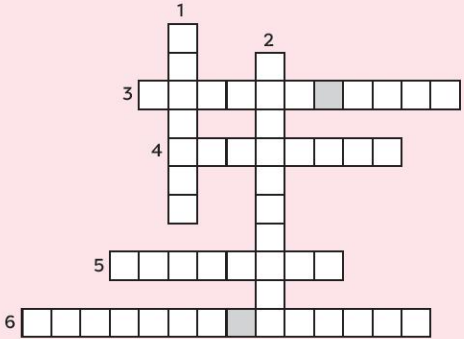
DOWN
1. Lan lives in a ____________ family that consists of her parents and younger sister.
2. The older ______________ usually has more traditional views.
ACROSS
3. My father limits my _____________. I can only use my laptop and smartphone to watch videos or check social media for two hours a day.
4. I live with my ______________ family in a big house, and I'm very close not only to my parents, but also to my grandparents, aunt, and uncle.
5. Teenagers often come into __________ with their parents.
6. My sister is a true ____________. She has used computers and smartphones since she was young and is very good at using them.
Bài 13 :
a. Add more words to the list, then complete sentences 1-6 with the bold words. Listen and repeat.
(Thêm các từ khác vào danh sách, sau đó hoàn thành câu 1-6 với các từ in đậm. Lắng nghe và lặp lại.)
|
Words to talk about fashion trends Materials: leather, ________________________________________________________ Adjectives to describe: Good-looking: stylish, pretty, ___________________________________________ Bad-looking: silly, ugly, ________________________________________________ • Other: practical, suitable, _____________________________________________ |
1. My shoes are very comfortable and _______________. People always ask me where I got them.
2. Headscarves are a new _______________ this year. You'll see many girls and women wearing scarves.
3. These clothes look so _______________. I don't know who would buy them. People will laugh at them.
4. Many women's shoe designs aren't _______________. Your feet will hurt if you wear them all day.
5. On Tết holiday, you should wear a shirt that is _______________ for visiting your relative's house.
6. I don't wear _____________ because I don't think animals should be hurt to make clothes.
Bài 14 :
a. Read the words and definitions and fill in the blanks. Listen and repeat.
(Đọc các từ và định nghĩa và điền vào chỗ trống. Lắng nghe và lặp lại.)
|
influence: the effect that somebody or something has on the way someone thinks or acts (ảnh hưởng: ảnh hưởng mà ai đó hoặc một cái gì đó có trên cách ai đó suy nghĩ hoặc hành động) behavior: how someone acts (hành vi: cách ai đó hành động) respect: act in a way that shows you are aware of someone's rights, wishes, etc. (tôn trọng: hành động theo cách cho thấy bạn nhận thức được quyền, mong muốn của ai đó, v.v.) ignore: pay no attention to something (bỏ qua: không chú ý đến một cái gì đó) curfew: a time when children must be home in the evening (giờ giới nghiêm: thời gian trẻ phải ở nhà vào buổi tối) permission: the right to do something that is given to you by someone else (sự cho phép: quyền làm điều gì đó được trao cho bạn bởi người khác) privacy: the state of being alone and not watched by other people (riêng tư: trạng thái ở một mình và không bị người khác theo dõi) |
1. When working in teams, you should respect other people's opinions and not make decisions on your own.
2. I need to get my mom's ________________ when I want to go out with my friends.
3. Sarah has a 9:30 p.m. ________________. She has to be home before that.
4. As children get older, they want to have more ________________ and stop sharing everything with their parents.
5. Tom's ________________ has become quite strange. He doesn't talk much and always stays in his room.
6. Why did you ________________ my messages? I sent you so many, and you never replied!
7. Movies can be a bad ________________ on children. Parents should know what their children are watching.
Bài 15 :
a. Match the words with the descriptions. There are two extra words which you do not need to use.
(Ghép các từ với các mô tả. Có hai từ bị thừa mà bạn không cần phải sử dụng.)
|
stylish practical suitable outskirts rural |
1. fashionable and attractive
2. good for a special purpose or time
3. parts of a town or city that are furthest from the center
Bài 16 :
b. Fill in the blanks using the words in the box. There are two extra words which you do not need to use.
(Điền vào chỗ trống sử dụng các từ trong hộp. Có hai từ bị thừa mà bạn không cần phải sử dụng.)
|
manage trend influence ignore privacy |
1. I usually _______________ the latest fashion. I don't care what's popular and I just wear what I like.
2. Both of my brothers were a big ____________on me. I'm really similar to both of them.
3. My sister doesn't give me any ______________ She just walks into my room without asking.
Bài 17 :
Vocabulary
Family qualities (Những phẩm chất trong gia đình)
a) Listen and repeat.
(Nghe và lặp lại.)
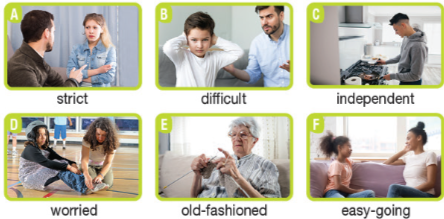
A. strict: nghiêm khắc
B. difficult: khó tính
C. independent: tự lập
D. worried: lo lắng
E. old – fashioned: lạc hậu
F. easy – going: dễ tính
Bài 18 :
b) Complete the statements (1-6) with the words (A-F) in Exercise 1a.
(Hoàn thành các câu (1-6) với các từ (A-F) trong Bài tập 1a.)
1. My brother Jim is a(n) ____________ boy; he does all his own cooking and laundry.
2. Tony is a ____________ child; he doesn’t listen to his parents.
3. Susan is ____________; she never gets mad with her children.
4. My mum doesn’t let me do anything on my own, she’s always ____________ about me.
5. Nancy’s father is quite ____________; he punishes her when she breaks the rules.
6. Aunt Peggy is ____________; she doesn’t have a mobile phone.
Bài 19 :
Vocabulary
Common family complaints (Những lời phàn nàn phổ biến trong gia đình)
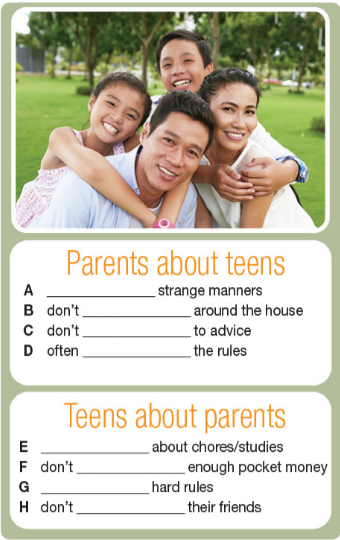
4. Fill in each gap with have, give, break, nag, listen, help, set or like. Then listen and check.
(Điền vào mỗi chỗ trống với have, give, break, nag, listen, help, set hoặc like. Sau đó nghe và kiểm tra.)
Bài 20 :
1. Complete the sentences with the words below.
(Hoàn thành các câu với các từ dưới đây.)

1 Some parents feel powerless because their teenagers don't listen to them.
(Một số cha mẹ cảm thấy bất lực vì con cái không nghe lời họ.)
2 I have a very good _________ with my grandparents; we get along very well.
3 Jack can sometimes be so _________ and thinks only about himself.
4 I feel sad; I had a terrible _________ with my mum.
5 Karen is very _________; she always gets her work done.
6 Most teenagers like to follow the latest fashion _________
Bài 21 :
Mark the letter A, B, C, or D to indicate the word(s) CLOSEST in meaning to the underlined word(s) in each of the following questions.
Despite being a kid, Tuan always helps his mother do the chores every day.
-
A.
homework
-
B.
works
-
C.
housework
-
D.
house duties
Bài 22 :
Mark the letter A, B, C, or D to indicate the word(s) CLOSEST in meaning to the underlined word(s) in each of the following questions.
Many parents find it hard to understand their children when they are teenagers.
-
A.
adults
-
B.
elders
-
C.
adolescents
-
D.
kids
Bài 23 :
Mark the letter A, B, C, or D to indicate the word(s) CLOSEST in meaning to the underlined word(s) in each of the following questions.
Mary has a strong desire to make independent decisions.
-
A.
dependent
-
B.
self-confident
-
C.
self-confessed
-
D.
self-determining
Bài 24 :
4. Complete the sentences with the correct form of the verbs below. Then listen again and check.
(Hoàn thành câu với dạng đúng của động từ dưới đây. Sau đó nghe lại và kiểm tra.)

1 Did he _________________ your room?
2 We need to _________________ the room nice for her.
3 It _________________ him a few days to feel comfortable there, though.
4 Did he have to _________________ the homework?
5 He actually _________________ well in some subjects.
6 Will she _________________ her friends and family?
Bài 25 :
Vocabulary
Family qualities
(Phẩm chất gia đình)
1. Complete the sentences (1-6) with the words in the list.
(Hoàn thành các câu (1-6) với các từ trong danh sách.)

1 Tom is ___________; he doesn't get worried easily.
2 His sister, Lina, is ___________ and wants to do things her way.
3 His mum isn't ___________ about her children; she knows they can take care of themselves.
4 His dad can be ___________ with his children at times - especially when they don't do what he says.
5 Tom has got a ___________ grandfather who isn't easy to please.
6 His grandmother is sweet but she's rather ___________; she is really behind the times.
Bài 26 :
Common family complaints
(Những than phiền phổ biến trong gia đình)
5. Choose the correct option.
(Chọn phương án đúng.)
1 Mary thinks her daughter has/gives strange manners.
2 My mum and dad often nag/like me about household chores.
3 My son doesn't listen/help around the house.
4 Tina and Kim feel like their parents don't set/give them enough pocket money.
5 Mr and Mrs Green complain that their children don't listen/give to their advice.
6 Sometimes Lisa feels that her parents set/ nag hard rules.
7 Brian complains that his son often sets/ breaks the rules.
8 John complains that his parents don't have/like his friends.
Bài 27 :
6. Read the sentences and fill in the missing letters.
(Đọc các câu và điền các chữ cái còn thiếu.)
OUR PRECIOUS FAMILY
1 In my family, our parents don't nag us about c_ _ _ _ _.
2 They give us enough p_ _ _ _ _ money.
3 They never s_ _ hard rules.
4 They l_ _ _ our friends and often invite them to our house.
5 Our parents want us to h_ _ _ good manners.
6 We always listen to their a_ _ _ _ _ about the money.
7 My brother and I always h_ _ _ around the house.
8 My parents work hard to raise us. We respect them and never b_ _ _ _ the rules.
We are a happy family.
What's your family like?
Bài 28 :
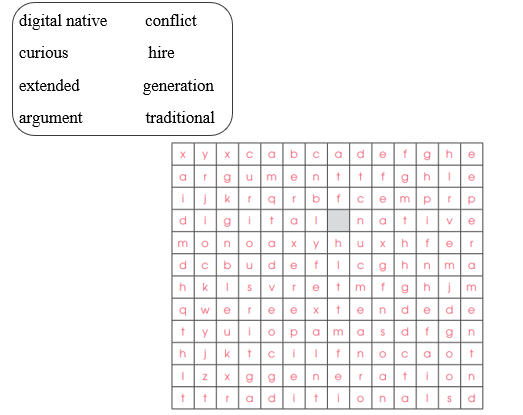
1. Find the following words in the word search.
(Tìm các từ sau trong phần tìm kiếm từ.)
Bài 29 :
2. Choose the best answers to complete the sentences.
(Chọn câu trả lời đúng nhất để hoàn thành câu.)
1. It is impossible to avoid daily __________ when you live with your extended family.
A. arguments
B. views
C. attitudes
D. characteristics
2. Older generations often have very __________ about how people should live.
A. common characteristics
B. traditional views
C. generational conflicts
D. cultural values
3. We should respect the __________ that have been passed down from the previous generations.
A. family conflicts
B. generational differences
C. cultural values
D. common behaviours
4. Educational games can help bridge the __________ between children, parents, and grandparents.
A. nuclear family
B. extended family
C. common behaviour
D. generation gap
5. Older generations can cope with difficulties because they have __________ many changes in their lives.
A. experienced
B. refused
C. looked for
D. influenced
6. My little brother always asks questions and is __________ to find out all the answers.
A. strange
B. curious
C. experienced
D. responsible
7. Gen Zers are very __________ as they always come up with new ideas or things.
A. experienced
B. curious
C. creative
D. traditional
8. My parents need to __________ someone to look after my grandparents.
A. lose
B. play
C. gain
D. hire
Bài 30 :
3. Complete the text using the words and phrases in the box.
(Hoàn thành đoạn văn sử dụng các từ và cụm từ trong khung.)

In Asian cultures, many people still live with their (1) __________, which usually consists of three or more generations. Members of such families often have (2) __________ or even come into conflict due to (3) __________. Older generations may have (4) __________ about gender roles and may want younger generations to agree with them. For example, many Asian parents still force their children to (5) __________ when choosing careers and other activities. They fail to realise that they may not share many (6) __________. The (7) __________ parents have had growing up don’t always apply to their children’s life. Therefore, it is very important for people of different generations to be (8) __________ new ideas. Understanding each other’s views and values will help to bridge the generation gap.





Danh sách bình luận