
















Cho hình hộp chữ nhật ABCD.EFGH có AB = AE = 2, AD = 3 và đặt \(\overrightarrow a = \overrightarrow {AB} \), \(\overrightarrow b = \overrightarrow {AD} \), \(\overrightarrow c = \overrightarrow {AE} \). Lấy điểm M thỏa mãn \(\overrightarrow {AM} = \frac{1}{5}\overrightarrow {AD} \) và điểm N thỏa mãn \(\overrightarrow {EN} = \frac{2}{5}\overrightarrow {EC} \).
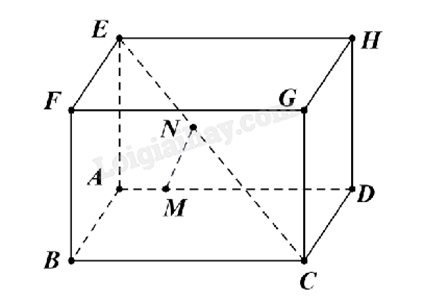
a) \(\overrightarrow {MA} = - \frac{1}{5}\overrightarrow b \).
b) \(\overrightarrow {EN} = \frac{2}{5}\left( {\overrightarrow a - \overrightarrow b + \overrightarrow c } \right)\).
c) \(\left( {m.\overrightarrow a + n.\overrightarrow b + p.\overrightarrow c } \right) = {m^2}.{\overrightarrow a ^2} + {n^2}.{\overrightarrow b ^2} + {p^2}.{\overrightarrow c ^2}\) với m, n, p là các số thực
d) \(MN = \frac{{\sqrt {61} }}{5}\).
a) \(\overrightarrow {MA} = - \frac{1}{5}\overrightarrow b \).
b) \(\overrightarrow {EN} = \frac{2}{5}\left( {\overrightarrow a - \overrightarrow b + \overrightarrow c } \right)\).
c) \(\left( {m.\overrightarrow a + n.\overrightarrow b + p.\overrightarrow c } \right) = {m^2}.{\overrightarrow a ^2} + {n^2}.{\overrightarrow b ^2} + {p^2}.{\overrightarrow c ^2}\) với m, n, p là các số thực
d) \(MN = \frac{{\sqrt {61} }}{5}\).
Dựa vào khái niệm vecto cùng phương, cùng hướng, cách xác định độ dài vecto, quy tắc cộng, trừ, nhân vecto với một số, quy tắc hình hộp.
a) Đúng. Ta có \(\overrightarrow {MA} = - \overrightarrow {AM} \)
\(= - \frac{1}{5}\overrightarrow {AD} = - \frac{1}{5}\overrightarrow b \).
b) Sai. \(\overrightarrow {EN} = \frac{2}{5}\overrightarrow {EC} \)
\(= \frac{2}{5}\left( {\overrightarrow {EF} + \overrightarrow {EH} + \overrightarrow {EA} } \right) \)
\(= \frac{2}{5}\left( {\overrightarrow a + \overrightarrow b + \overrightarrow c } \right)\).
c) Đúng. \(\left( {m.\overrightarrow a + n.\overrightarrow b + p.\overrightarrow c } \right) \)
\(= {m^2}.{\overrightarrow a ^2} + {n^2}.{\overrightarrow b ^2} + {p^2}.{\overrightarrow c ^2} + 2mn\overrightarrow a .\overrightarrow b + 2np\overrightarrow b .\overrightarrow c + 2mp\overrightarrow a .\overrightarrow c \)
\( = {m^2}.{\overrightarrow a ^2} + {n^2}.{\overrightarrow b ^2} + {p^2}.{\overrightarrow c ^2}\)
(vì \(\overrightarrow a \), \(\overrightarrow b \), \(\overrightarrow c \) đôi một vuông góc nên \(\overrightarrow a .\overrightarrow b = \overrightarrow b .\overrightarrow c = \overrightarrow b .\overrightarrow c = 0\)).
d) Đúng. \(\overrightarrow {MN} = \overrightarrow {MA} + \overrightarrow {AE} + \overrightarrow {EN} \)
\(= - \frac{1}{5}\overrightarrow b + \overrightarrow c + \frac{2}{5}\left( {\overrightarrow a + \overrightarrow b + \overrightarrow c } \right) \)
\(= \frac{2}{5}\overrightarrow a + \frac{1}{5}\overrightarrow b + \frac{3}{5}\overrightarrow c \).
\(M{N^2} = {\left( {\overrightarrow {MN} } \right)^2} \)
\(= {\left( {\frac{2}{5}\overrightarrow a + \frac{1}{5}\overrightarrow b + \frac{3}{5}\overrightarrow c } \right)^2} \)
\(= \frac{4}{{25}}{\overrightarrow a ^2} + \frac{1}{{25}}{\overrightarrow b ^2} + \frac{9}{{25}}{\overrightarrow c ^2} \)
\(= \frac{4}{{25}}.4 + \frac{1}{{25}}.9 + \frac{9}{{25}}.4 = \frac{{61}}{{25}}\).
Suy ra \(MN = \frac{{\sqrt {61} }}{5}\).








Danh sách bình luận