












3. Listen to a talk show with a professor, Dr. Robert, about how people in metropolitan cities will travel in the next 50 years. Tick (✔) the five words you can listen to from the talk show and match with their definitions a-e.
(Nghe một chương trình trò chuyện với giáo sư, Tiến sĩ Robert, về cách người dân ở các thành phố đô thị sẽ đi lại trong 50 năm tới. Đánh dấu ( ✔) năm từ bạn có thể nghe từ chương trình trò chuyện và nối với định nghĩa của chúng từ a-e.)
1 ☐ sustainable
2 ☐ metropolitan
3 ☐ transform
4 ☐ infrastructure
5 ☐ innovations
6 ☐ monitor
7 ☐ high-speed
8 ☐ rush hour
a_____________: relating to a city and the densely populated surrounding areas
b_____________: to change the character or appearance of something in order to improve it
c_____________: the busy part of the day when towns and cities are crowded
d_____________: used to describe something that moves very quickly
e_____________: new ideas or methods
Bài nghe
Nick: Good morning. I'm Nick from CNN Discovery Channel. Joining me for our discussion is a technology professor, Doctor Robert.
Dr.Robert: Hello, Nick. Thank you for having me today.
Nick: Doctor Robert, how did you travel here this morning?
Dr.Robert: Well, I took the underground to get here.
Nick: Is the underground the most convenient means of transport in your city?
Dr.Robert: Yeah, kind of. But I have to say it's so crowded and sometimes you have to stand all the way home.
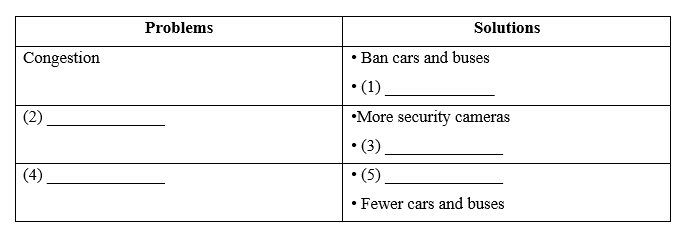
Nick: Yes, road congestion and air pollution still exist in such metropolitan cities as. New York, Mumbai, Shanghai, etc. With the unprecedented growth of population, what will future transportation in those cities look like?
Dr.Robert: Well, I believe that technological advances will transform our roads and skies; one of the future transport innovations is the development of underground roads, a system of tunnels will be built and vehicles will be lowered underground via elevators.
Nick: What a brilliant idea. Taking a taxi or driving a motorbike underground is supposed to be more weatherproof. No worries about rainy, sunny or snowy weather.
Dr.Robert: Yes, but it's still a plan.
Nick: I've also heard about maglev trains. Are they more convenient than traditional ones?
Dr.Robert: Yes, definitely. They are high - speed trains that can reach up to 600 kilometres per hour. Dr.Robert: They use power from Electro magnets to travel with less noise and less vibration. Maglev trains are not powered by fossil fuels, so they are better for the environment. Another means of future transport is flying cars.
Nick: What does a flying car look like?
Dr.Robert: It's not too big and doesn't use too much gas.
Nick: How about the speed?
Dr.Robert: It can reach 120 kilometers per hour on the ground and nearly 200 in the air. So owning a flying car will be a good idea to avoid traffic jams, especially during the rush hours.
Nick: Yeah. Thank you very much for spending time with us.
Tạm dịch
Nick: Chào buổi sáng. Tôi là Nick từ Kênh CNN Discovery. Tham gia cùng tôi trong cuộc thảo luận của chúng ta là giáo sư công nghệ, Tiến sĩ Robert.
Tiến sĩ Robert: Xin chào, Nick. Cảm ơn bạn đã có tôi ngày hôm nay.
Nick: Bác sĩ Robert, sáng nay ông đến đây bằng cách nào?
Tiến sĩ Robert: Tôi đã đi tàu điện ngầm để đến đây.
Nick: Tàu điện ngầm có phải là phương tiện giao thông thuận tiện nhất trong thành phố của bạn không?
Tiến sĩ Robert: Vâng, đại loại vậy. Nhưng phải nói là đông quá, có khi phải đứng suốt đường về.
Nick: Đúng vậy, tắc nghẽn giao thông và ô nhiễm không khí vẫn còn tồn tại ở các thành phố đô thị như. New York, Mumbai, Thượng Hải, v.v. Với sự gia tăng dân số chưa từng có, giao thông trong tương lai ở những thành phố đó sẽ như thế nào?
Tiến sĩ Robert: Tôi tin rằng những tiến bộ công nghệ sẽ biến đổi những con đường và bầu trời của chúng ta; Một trong những đổi mới về giao thông trong tương lai là phát triển đường ngầm, hệ thống đường hầm sẽ được xây dựng và các phương tiện sẽ được hạ xuống lòng đất bằng thang máy.
Nick: Thật là một ý tưởng tuyệt vời. Đi taxi hoặc lái xe máy dưới lòng đất được cho là sẽ chịu được thời tiết tốt hơn. Không cần lo lắng về thời tiết mưa, nắng hay tuyết.
Tiến sĩ Robert: Đúng, nhưng đó vẫn là một kế hoạch.
Nick: Tôi cũng đã nghe nói về tàu đệm từ. Chúng có tiện lợi hơn những cái truyền thống không?
Tiến sĩ Robert: Vâng, chắc chắn rồi. Chúng là những chuyến tàu tốc độ cao có thể đạt tốc độ lên tới 600 km một giờ. Tiến sĩ Robert: Họ sử dụng năng lượng từ nam châm Điện để di chuyển với ít tiếng ồn và ít rung động hơn. Tàu Maglev không chạy bằng nhiên liệu hóa thạch nên tốt hơn cho môi trường. Một phương tiện giao thông khác trong tương lai là ô tô bay.
Nick: Một chiếc ô tô bay trông như thế nào?
Tiến sĩ Robert: Nó không quá lớn và không tốn quá nhiều gas.
Nick: Còn tốc độ thì sao?
Tiến sĩ Robert: Nó có thể đạt tốc độ 120 km/h trên mặt đất và gần 200 km/h trên không. Vì vậy việc sở hữu một chiếc ô tô bay sẽ là một ý tưởng hay để tránh ùn tắc giao thông, đặc biệt là trong giờ cao điểm.
Nick: Ừ. Cảm ơn bạn rất nhiều vì đã dành thời gian với chúng tôi.
- Các từ được nhắc đến trong bài
2 ☑ metropolitan
3 ☑ transform
5 ☑ innovations
7 ☑ high-speed
8 ☑ rush hour
- Định nghĩa
a metropolitan: relating to a city and the densely populated surrounding areas
(đô thị: liên quan đến một thành phố và các khu vực đông dân cư xung quanh)
b transform: to change the character or appearance of something in order to improve it
(biến đổi: thay đổi đặc tính hoặc diện mạo của một cái gì đó để cải thiện nó)
c rush hour: the busy part of the day when towns and cities are crowded
(giờ cao điểm: khoảng thời gian bận rộn trong ngày khi các thị trấn, thành phố đông đúc)
d high-speed: used to describe something that moves very quickly
(tốc độ cao: được sử dụng để mô tả một cái gì đó di chuyển rất nhanh)
e innovations: new ideas or methods
(đổi mới: ý tưởng hoặc phương pháp mới)







Danh sách bình luận