Bài 12 :
5.2 must vs have to and modals in the past
(must vs have to và động từ khiếm khuyết trong quá khứ)
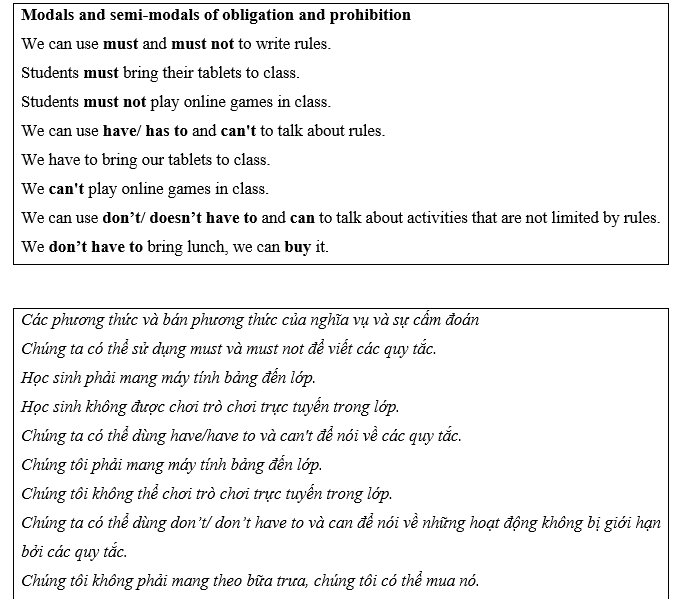
We use must and have to for obligation.
Must expresses obligation imposed by the speaker while have to expresses external obligation.
I must / have to study hard for the final exam.
You must keep you room tidy, Jimmy.
In Viet Nam, all children have to go to school at the age of six.
We use had to for obligation in the past.
Mark had to stay home yesterday because he was ill.
We use may / might / could have for speculating about past events.
She may / might / could have sent me a message. (= It's possible she sent me a message, but I don't know.)
We use may / might not have (but not could not have) as the negative.
She might / may not have had her phone with her. (= It's possible she didn't have it, but I don't know.)
We use must have and can't / couldn't have to make logical deductions about the past.
You can't / couldn't have seen the new Batman film. It isn't out yet. (It's not possible that you saw it.)
You must have seen an old Batman film. (= That is the only possible explanation.)
We use should / shouldn't have to criticise past actions.
You should have taken a taxi. It wasn't safe to walk.
She shouldn't have phoned me so late. I was asleep.
Tạm dịch
Chúng ta sử dụng must và have to cho nghĩa vụ.
Must thể hiện nghĩa vụ do người nói áp đặt trong khi have to thể hiện sự bắt buộc đến từ bên ngoài.
Tôi phải học chăm chỉ cho kỳ thi cuối kỳ.
Bạn phải giữ phòng của bạn gọn gàng, Jimmy.
Ở Việt Nam, tất cả trẻ em phải đến trường từ sáu tuổi.
Chúng ta sử dụng had to cho nghĩa vụ trong quá khứ.
Mark đã phải ở nhà ngày hôm qua vì anh ấy bị ốm.
Chúng ta sử dụng may / might / could have để suy đoán về các sự kiện trong quá khứ.
Cô ấy có thể đã gửi cho tôi một tin nhắn. (= Có thể cô ấy đã gửi tin nhắn cho tôi, nhưng tôi không biết.)
Chúng ta sử dụng may / might not have (nhưng không dùng could not have) ở dạng phủ định.
Cô ấy có thể không mang theo điện thoại bên mình. (= Có thể cô ấy không có, nhưng tôi không biết.)
Chúng ta sử dụng must have và can't / could not have để suy luận logic về quá khứ.
Bạn không thể xem bộ phim Batman mới. Nó vẫn chưa ra. (Không thể là bạn đã nhìn thấy nó.)
Bạn hẳn đã xem một bộ phim Batman cũ. (= Đó là lời giải thích khả thi duy nhất.)
Chúng ta sử dụng should / should not have để chỉ trích hành động trong quá khứ.
Bạn nên đi taxi. Nó không an toàn để đi bộ.
Lẽ ra cô ấy không nên gọi điện cho tôi muộn như vậy. Tôi đã ngủ.
1 Choose the best words (a, b or c) to complete the sentences.
(Chọn từ đúng nhất (a, b hoặc c) để hoàn thành câu.)
1 You look freezing. You_____worn a coat.
a should have
b might not have
c could have
2 Ask that question again; the teacher _____ heard you.
a shouldn't have
b could have
c can't have
3 Your brother has been using your email account. You _____ told him your password.
a must have
b mustn't have
c couldn't have
4 Jack is really upset. You _____ laughed at him!
a may not have
b can't have
c shouldn't have
5 I sent you a postcard, but you _____ received it yet.
a may have
b should have
c might not have
6 Your phone is dead again. The instruction says you _____ recharge it after use.
a don't have to
b must have to
c have to
7 I can't remember when I last saw you. Maybe it was last April, or it ____ been in the summer.
a might have
b must have
c can't have
8 You ____ invite Sam to your party. He's a really nice guy.
a have to
b must
c don't have to
9 We were nearly late yesterday. We ____ run for the bus.
a have to
b must
c had to






















Danh sách bình luận