












1. Complete the text with the words in the box.
(Hoàn thành đoạn văn với những từ trong khung.)

Hoi An Ancient Town
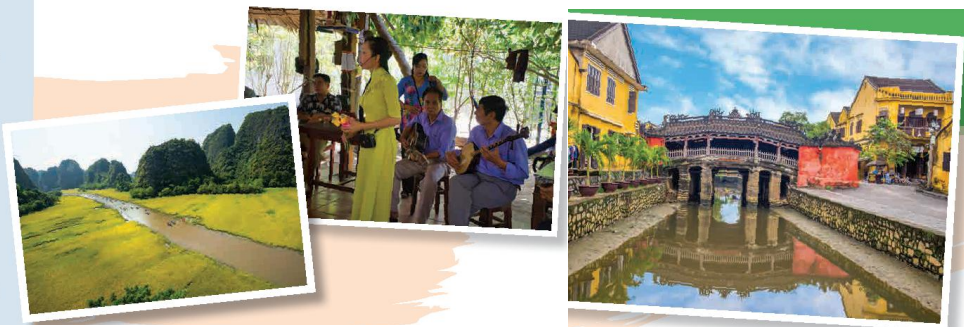
Hoi An Ancient Town is (1) _______ in Viet Nam’s central Quang Nam Province on the banks of the Thu Bon River. In 1999, the old town was recognised as a World Heritage Site by UNESCO. As a well preserved example of a Southeast Asian trading port dating from the 15th to 19th century, its (2) _______ is a mixture of local and foreign styles. The town consists of a well preserved complex of thousands of timber frame buildings, with brick or wooden walls, including an open (3) _______, pagodas, temples, and other structures. The houses are arranged side by side in tight, unbroken rows along narrow (4) _______ streets. The original street plan has also stayed the same.
One of the most famous (5) _______ is the Japanese Bridge Pagoda (Cau Pagoda), which was (6) _______ over a small canal flowing out into the Thu Bon River. It’s part of a 420-year-old bridge, painted in beautiful red and pink colours, with a wooden pagoda roof. The bridge has a fascinating history dating back to the 17th century. (7) _______ several times, this important monument is well preserved and has become the (8) _______ of Hoi An and the highlight of any walking tour in the old town.
Nghĩa của từ vựng:
- restored: khôi phục
- built: xây dựng
- market: chợ
- attractions: thu hút
- architecture: ngành kiến trúc
- located: xác định vị trí
- symbol: biểu tượng
- pedestrian: người đi bộ

Hoi An Ancient Town
Hoi An Ancient Town is (1) located in Viet Nam’s central Quang Nam Province on the banks of the Thu Bon River. In 1999, the old town was recognised as a World Heritage Site by UNESCO. As a well preserved example of a Southeast Asian trading port dating from the 15th to 19th century, its (2) architecture is a mixture of local and foreign styles. The town consists of a well preserved complex of thousands of timber frame buildings, with brick or wooden walls, including an open (3) market, pagodas, temples, and other structures. The houses are arranged side by side in tight, unbroken rows along narrow (4) pedestrian streets. The original street plan has also stayed the same.
One of the most famous (5) attractions is the Japanese Bridge Pagoda (Cau Pagoda), which was (6) built over a small canal flowing out into the Thu Bon River. It’s part of a 420-year-old bridge, painted in beautiful red and pink colours, with a wooden pagoda roof. The bridge has a fascinating history dating back to the 17th century. (7) Restored several times, this important monument is well preserved and has become the (8) symbol of Hoi An and the highlight of any walking tour in the old town.
(Phố cổ Hội An
Phố cổ Hội An nằm ở trung tâm tỉnh Quảng Nam của Việt Nam bên bờ sông Thu Bồn. Năm 1999, khu phố cổ được UNESCO công nhận là Di sản Thế giới. Là một ví dụ được bảo tồn tốt về một thương cảng Đông Nam Á có niên đại từ thế kỷ 15 đến thế kỷ 19, kiến trúc của nó là sự pha trộn giữa phong cách địa phương và nước ngoài. Thị trấn bao gồm một khu phức hợp được bảo tồn tốt gồm hàng ngàn tòa nhà khung gỗ, với những bức tường gạch hoặc gỗ, bao gồm một chợ mở, chùa, đền thờ và các công trình kiến trúc khác. Những ngôi nhà được sắp xếp cạnh nhau thành những hàng chặt chẽ, liền mạch dọc theo những con phố đi bộ hẹp. Kế hoạch đường phố ban đầu cũng được giữ nguyên.
Một trong những điểm tham quan nổi tiếng nhất là Chùa Cầu Nhật Bản (Chùa Cầu), được xây dựng trên một con kênh nhỏ chảy ra sông Thu Bồn. Nó là một phần của cây cầu 420 tuổi, được sơn màu đỏ và hồng tuyệt đẹp, với mái chùa bằng gỗ. Cây cầu có một lịch sử hấp dẫn có niên đại từ thế kỷ 17. Được trùng tu nhiều lần, di tích quan trọng này được bảo tồn tốt và đã trở thành biểu tượng của Hội An và là điểm nhấn của bất kỳ chuyến đi bộ nào trong khu phố cổ.)







Danh sách bình luận