











a. Match the words to the definitions.
(Nối các từ với các định nghĩa.)
|
1. population density |
A. the process of towns and cities growing as people move to them from rural places |
|
2. grid |
B. someone who moves from one place to another |
|
3. urbanization |
C. the amount of space covered by a piece of land |
|
4. housing |
D. places where people can live |
|
5. migrant |
E. the number of people living in a particular amount of space |
|
6. upgrade |
F. replace a machine or a system with something better or improve it |
|
7. area |
G. a system of wires or pipes used to power a large area |

1. population density => E. the number of people living in a particular amount of space
(mật độ dân số => E. số người sống trong một khoảng không gian cụ thể)
2. grid => G. a system of wires or pipes used to power a large area
(lưới điện => G. hệ thống dây điện hoặc đường ống dùng để cấp điện cho một khu vực rộng lớn)
3. urbanization => A. the process of towns and cities growing as people move to them from rural places
(đô thị hóa => A. quá trình phát triển của các thị trấn và thành phố khi người dân từ nông thôn di cư đến đây)
4. housing => D. places where people can live
(nhà ở => D. nơi con người có thể sống)
5. migrant => B. someone who moves from one place to another
(người di cư => B. người di chuyển từ nơi này đến nơi khác)
6. upgrade => F. replace a machine or a system with something better or improve it
(nâng cấp => F. thay thế một cái máy hoặc một hệ thống bằng thứ gì đó tốt hơn hoặc cải tiến nó)
7. area => C. the amount of space covered by a piece of land
(diện tích => C. lượng không gian được bao phủ bởi một mảnh đất)

Các bài tập cùng chuyên đề
Bài 1 :
1. Listen and repeat. (Nghe và lặp lại.)
1. rural migration (n): sự di cư về các thành phố lớn
2. overpopulation (n): quá tải dân số
3. slum (n): khu ổ chuột
4. industrial area (n): khu công nghiệp
5. high-rise building (n): toà nhà cao tầng
6. megacity (n): siêu đô thị
Bài 2 :
2. Complete the statements with the words/phrases (1-6) from Exercise 1.
(Hoàn thành các phát biểu sau với các từ/ cụm từ (1-6) từ bài tập 1.)
1. This part of the city is a(n) _____ with lots of factories.
2. Some poor people ended up living in a(n) _____ because they couldn't afford proper housing.
3. _____ can cause lots of trouble on public transport in a city, especially during rush hour.
4. _____ happens when people move to the city from the countryside to find better jobs.
5. People who live in the centre of a(n) _____ may take hours to get around.
6. The city council plans to construct a new _____ in a suburb of Newcastle to provide more housing.
Bài 3 :
b. Read and fill in the blanks.
(Đọc và điền vào chỗ trống.)
|
migrants population density area housing upgraded urbanization grid |
(1) ___ is caused by (2) ___ moving into a town or a city, and it isn't always a good thing. Sometimes, the (3) ___ can get too high and cause problems because there are so many people. One thing it can affect is the (4) ___ . There might not be enough apartments or houses in a certain (5) ___ , so people won't have anywhere to live. It often means that the town or city's infrastructure has to be (6) ___ This can include building more hospitals and apartments, as well as improving the power (7) _______
Bài 4 :
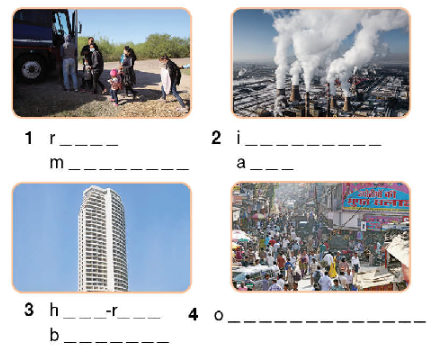
a) Look at the pictures and fill in the missing letters.
(Nhìn vào các bức tranh và điền vào các chữ cái còn thiếu.)

Bài 5 :
Vocabulary (Từ vựng)
Rural - urban migration (Sự di cư từ nông thôn lên thành phố)
5. Choose the correct option.
(Chọn đáp án đúng.)
1. Low wages/access may force people to leave their towns or villages.
2. Lack of public/recreational activities makes young people move to cities.
3. Access to goods/industries and services is available but sometimes expensive in cities.
4. Crop infrastructure/failure may be due to global warming.
5. There are more industries/goods in a megacity, which creates more jobs.
6. Poor infrastructure/access in rural areas leads people to big cites.
Bài 6 :
6. Fill in each gap with infrastructure, recreational, failure, industries, goods or wages.
(Điền vào mỗi chỗ trống với infrastructure, recreational, failure, industries, goods hoặc wages.)
A: Hey John! How are you doing?
B: I'm alright. You know what? I'm thinking of moving to the city.
A: Why is that? Are you going to leave the quiet life of our village?
B: Well, although I like the peaceful and slow pace of life here, I must go. 1) _____ are higher in the city and there are more 2) _____ activities there.
A: Are you sure about that? I know there are very few job opportunities here, but the locals are well-mannered and caring, and you live a life that's far from stressful.
B: I really love the beautiful things in our town, but after the last crop 3) _____ I have no choice but to go to a big urban centre. There are certainly more 4) _____ that offer employment, and the city has better 5) _____ and public services than our rural area. I hope to get a job soon and find a spacious flat.
A: I hope you can afford all the 6) _____ the city can offer!