












5. Complete the text with the verbs in brackets.
(Hoàn thành văn bản với các động từ trong ngoặc.)
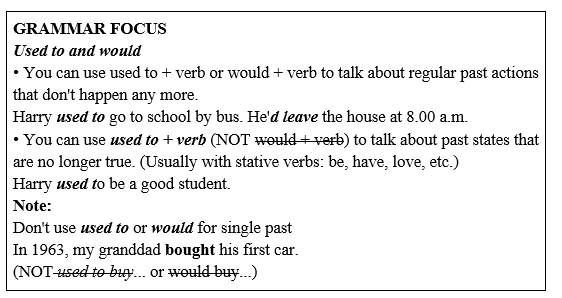
• Use would + verb (where possible)
• Use used to + verb (where would is not possible)
• Use the Past Simple (where would or used to are not possible)
Left or right?
Today, 75% of cars drive on the right, but it 1didn't always use to be (not always be) like that. In fact, everybody used to travel on the left! In Roman times, roads 2_________ (be) dangerous and travellers 3_________ (carry) swords in their right hands.
Travellers on horses 4_________ (ride) on the left side of the road so that the right hand was free to use the sword. Then Napoleon 5_________ (change) the rule. Why? Because he was a revolutionary! Before the French Revolution, the aristocracy 6_________ (travel) on the left and poor people 7_________ (stay) on the right. After the Revolution, the aristocracy joined the poor people on the right and driving on the right 8_________ (become) the new law. What about the rest of the world? China, Portugal, Sweden and parts of Canada used to drive on the left and only changed the law during the mid-twentieth century. More than fifty countries including the UK, Australia, Japan and India still drive on the left today.
2. used to be 6. would travel
3. would carry 7. would stay
4. would ride 8. became
5. changed
Left or right?
Today, 75% of cars drive on the right, but it 1didn't always use to be (not always be) like that. In fact, everybody used to travel on the left! In Roman times, roads 2used to be dangerous and travellers 3would carry swords in their right hands.
Travellers on horses 4would ride on the left side of the road so that the right hand was free to use the sword. Then Napoleon 5changed the rule. Why? Because he was a revolutionary! Before the French Revolution, the aristocracy 6would travel on the left and poor people 7would stay on the right. After the Revolution, the aristocracy joined the poor people on the right and driving on the right 8became the new law. What about the rest of the world? China, Portugal, Sweden and parts of Canada used to drive on the left and only changed the law during the mid-twentieth century. More than fifty countries including the UK, Australia, Japan and India still drive on the left today.
Tạm dịch:
Trái hay phải?
Ngày nay, 75% ô tô lái bên phải, nhưng không phải lúc nào cũng như vậy (không phải lúc nào cũng vậy). Trên thực tế, mọi người thường đi bên trái! Vào thời La Mã, những con đường từng rất nguy hiểm và những du khách sẽ cầm kiếm trên tay phải.
Du khách cưỡi ngựa đi bên trái đường để tay phải được tự do sử dụng kiếm. Sau đó, Napoléon V đã thay đổi quy tắc. Tại sao? Vì ông là một nhà cách mạng! Trước Cách mạng Pháp, tầng lớp quý tộc đi bên trái và những người nghèo ở bên phải. Sau Cách mạng, tầng lớp quý tộc cùng với người nghèo đi bên phải và lái xe bên phải đã trở thành luật mới, phần còn lại của thế giới thì sao? Trung Quốc, Bồ Đào Nha, Thụy Điển và một số vùng của Canada từng lái xe bên trái và chỉ thay đổi luật vào giữa thế kỷ 20. Ngày nay, hơn 50 quốc gia bao gồm Vương quốc Anh, Úc, Nhật Bản và Ấn Độ vẫn lái xe bên trái.







Danh sách bình luận