












3.2 The first conditional
(Câu điều kiện loại 1)
We use the first conditional to make predictions about the future.
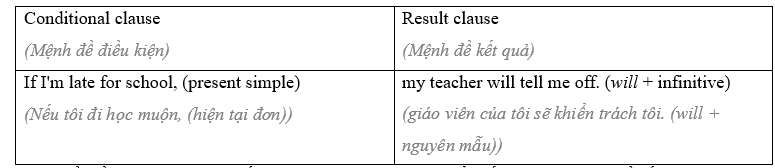
If I'm late for school, my teacher will tell me off.
We form the first conditional with the present simple in the conditional clause and will + infinitive in the result clause.

The conditional if clause usually comes first, but it can come after the result clause.
My teacher will tell me off if I'm late for school.
The modal verbs may, might and could can be used instead of will or won't in the result clause in order to make the prediction less certain.
Scientists may find a cure for cancer if governments invest more money in medical research.
Tạm dịch
Chúng ta sử dụng điều kiện đầu tiên để đưa ra dự đoán về tương lai.
Nếu tôi đi học muộn, giáo viên của tôi sẽ mắng tôi.
Chúng ta hình thành câu điều kiện loại 1 với thì hiện tại đơn trong mệnh đề điều kiện và will + nguyên mẫu trong mệnh đề kết quả.
Mệnh đề điều kiện if thường xuất hiện trước, nhưng nó có thể xuất hiện sau mệnh đề kết quả.
Giáo viên của tôi sẽ mắng tôi nếu tôi đi học muộn.
Các động từ khiếm khuyết may, might và could có thể được dùng thay cho will hoặc won't trong mệnh đề kết quả để làm cho dự đoán kém chắc chắn hơn.
Các nhà khoa học có thể tìm ra cách chữa bệnh ung thư nếu chính phủ đầu tư nhiều tiền hơn vào nghiên cứu y học.
1 Complete the first conditional sentences. Use the verbs in brackets.
(Hoàn thành các câu điều kiện loại 1. Sử dụng động từ trong ngoặc.)
1 If I __________ (not phone) my parents, they __________ (be) upset.
2 If I __________ (tell) you a secret, __________ (you/promise) not to tell anybody?
3 We __________ (have) a barbecue tomorrow if it __________ (not rain).
4 My mum __________ (not buy) me a new phone if I __________ (lose) this one.
5 What __________ (you/do) if you __________ (feel) unwell tomorrow morning?
6 If you __________ (give) me your number, I __________ (be able to) text you.
7 Joe __________ (make) Sally very happy if he __________ (send) her some chocolates.
8 If you __________ (not shout) at me, I __________ (not get) angry.
Cấu trúc câu điều kiện loại 1: If + S + V(s/es), S + will / can + Vo (nguyên thể)

1 If I don't phone my parents, they will be upset.
(Nếu tôi không gọi điện thoại cho bố mẹ tôi, họ sẽ buồn.)
2 If I tell you a secret, will you promise not to tell anybody?
(Nếu tôi nói cho bạn biết một bí mật, bạn sẽ hứa không nói với ai chứ?)
3 We will have a barbecue tomorrow if it doesn't rain.
(Chúng tôi sẽ tổ chức tiệc nướng vào ngày mai nếu trời không mưa.)
4 My mum won't buy me a new phone if I lose this one.
(Mẹ tôi sẽ không mua cho tôi một chiếc điện thoại mới nếu tôi làm mất cái này.)
5 What will you do if you feel unwell tomorrow morning?
(Bạn sẽ làm gì nếu cảm thấy không khỏe vào sáng mai?)
6 If you give me your number, I will be able to text you.
(Nếu bạn cho tôi số của bạn, tôi sẽ có thể nhắn tin cho bạn.)
7 Joe will make Sally very happy if he sends her some chocolates.
(Joe sẽ làm cho Sally rất hạnh phúc nếu anh ấy gửi cho cô ấy một ít sô cô la.)
8 If you don't shout at me, I won't get angry.
(Nếu bạn không hét vào mặt tôi, tôi sẽ không nổi giận.)






Danh sách bình luận