












British public school
In the UK, 93% of children go to state schools, which are funded by the government. The remaining 7% go to private schools, which the government does not fund or control. The students pay fees to attend these schools. A small group of very old private schools are, confusingly, known as 'public schools'. These include Eton College, which has educated nineteen British Prime Ministers over the past three centuries- as well as many other famous people from around the world, including Prince William and Prince Harry, actor Hugh Laurie and the former king of Nepal.
To many people, these public schools seem very odd and old-fashioned, with their strange uniforms and confusing traditions. For example, all of the public schools divide the academic year into three terms. At Eton College, these are called 'halves', but at Charterhouse they're called 'quarters' (and the shortest of the three is known as the 'long quarter').
Although private schools seem irrelevant to most British people, the influence they have on society is very real. That is because a very large number of people in important positions attended these schools, including 71% of senior judges and 62% of senior officers in the armed forces. Some people even argue that the UK parliament does not represent the country because 32% of MPs are privately educated.
1 SPEAKING Describe the photo, which shows children having breakfast at a 'public school' in England. How is it different from the canteen at your school? Would you like to eat here? Why? / Why not?
(NÓI Mô tả bức ảnh chụp những đứa trẻ đang ăn sáng tại một 'trường công lập' ở Anh. Nó khác với căng tin ở trường của bạn như thế nào? Bạn có muốn ăn ở đây không? Tại sao? / Tại sao không?)
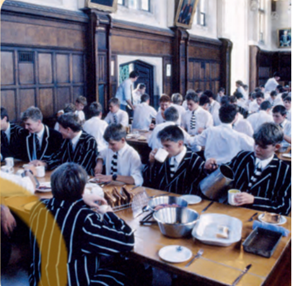
- The picture shows a school cafeteria or eating room, where many students are gathered, all wearing their school uniforms. Some students are drinking milk from cups, while there is bread on the table. The room appears to be quite crowded with many students present. It can be assumed that it is a busy place, with students chatting and eating together.
(Bức tranh cho thấy một nhà ăn hoặc phòng ăn của trường, nơi có nhiều học sinh đang tụ tập, tất cả đều mặc đồng phục học sinh. Một số học sinh đang uống sữa từ cốc trong khi có bánh mì trên bàn. Căn phòng có vẻ khá đông đúc với nhiều sinh viên có mặt. Có thể cho rằng đó là một nơi náo nhiệt với các sinh viên trò chuyện và ăn uống cùng nhau.)
- I think they are having breakfast at a 'public school' in England because they’re all wearing uniform and eating bread and drinking milk. They are popular things for breakfast there.
(Tôi nghĩ họ đang ăn sáng tại một 'trường công lập' ở Anh vì tất cả họ đều mặc đồng phục và ăn bánh mì và uống sữa. Chúng là những thứ phổ biến cho bữa sáng ở đó.)
- At my school, we have a more modern-looking cafeteria with individual tables and chairs. The food is served from a counter and students can choose from a variety of options.
(Ở trường tôi, chúng tôi có một nhà ăn trông hiện đại hơn với bàn ghế cá nhân. Thức ăn được phục vụ từ quầy và học sinh có thể chọn từ nhiều lựa chọn khác nhau.)
- If I can choose, I wouldn’t like to eat as in the picture because I like the feeling of being alone when I am eating and I can choose to eat any food I want at the canteen.
(Nếu được chọn, tôi sẽ không thích ăn như trong hình vì tôi thích cảm giác một mình khi đang ăn và tôi có thể chọn ăn bất kỳ món nào mình muốn tại căng tin.)






Danh sách bình luận