











|
We use to-infinitives: . after plan, agree, decide, ask, hope, promise, want, need, accept, refuse, etc. She planned not to spend her holiday in Paris. . after would love and would like. I would like to visit Hạ Long Bay one day. . to express purposes. We hiked to the top of the mountain to take photos. . after it + be + adjective. It is easy to book a flight online. We use infinitives without to after: . modal verbs (can, must, should, etc.). We must arrive at the airport soon. . let and make. The teacher made us stay away from the coral reef. . had better. You had better save some money if you want to travel abroad. |
Tạm dịch:
|
Chúng ta sử dụng to-infinitive: . sau plan, agree, decide, ask, hope, promise, want, need, accept, refuse, v.v. Cô dự định không dành kỳ nghỉ của mình ở Paris. . sau would love và would like. Tôi muốn đến thăm Vịnh Hạ Long một ngày nào đó. . để diễn đạt mục đích. Chúng tôi leo lên đỉnh núi để chụp ảnh. . sau it + be + tính từ. Thật dễ dàng để đặt một chuyến bay trực tuyến. Chúng ta sử dụng động từ nguyên thể không có to sau: . động từ khiếm khuyết (can, must, should,, v.v.). Chúng ta phải đến sân bay sớm. . let và make. Giáo viên bắt chúng tôi tránh xa rạn san hô. . had better. Tốt hơn hết bạn nên tiết kiệm một số tiền nếu muốn đi du lịch nước ngoài. |
1. Put the verbs in brackets into to-infinitives or infinitives without to.
(Chia động từ trong ngoặc ở dạng nguyên thể có to hoặc dạng nguyên thể không có to.)
1. It is important _______ (finish) your hike before night falls.
2. Andrea would like _______ (see) the Great Barrier Reef one day.
3. Jennifer decided _______ (not/explore) the site on her own. She booked a tour instead.
4. We must _______ (wear) a good pair of hiking boots when we go hiking to Mount Fansipan.
5. My parents let me _______ (choose) the place for our summer holiday.
6. They refuse _______ (stay) in a hotel room without a view of the sea.
7. He had better _______ (book) a train ticket soon or there won’t be any left.
8. I planned _______ (not/travel) overseas this year; I’m saving money for my next English course.
Chúng ta sử dụng to-infinitive:
. sau plan, agree, decide, ask, hope, promise, want, need, accept, refuse, v.v.
. sau would love và would like.
. sau it + be + tính từ.
Chúng ta sử dụng động từ nguyên thể không có to
. động từ khiếm khuyết (can, must, should,, v.v.).
. let và make.
. had better.

1. It is important to finish your hike before night falls.
(Điều quan trọng là phải kết thúc chuyến đi bộ trước khi màn đêm buông xuống.)
2. Andrea would like to see the Great Barrier Reef one day.
(Andrea muốn một ngày nào đó được nhìn thấy Rạn san hô Great Barrier.)
3. Jennifer decided not to explore the site on her own. She booked a tour instead.
(Jennifer quyết định không tự mình khám phá địa điểm này. Thay vào đó cô ấy đã đặt một chuyến du lịch.)
4. We must wear a good pair of hiking boots when we go hiking to Mount Fansipan.
(Chúng ta phải mang một đôi giày leo núi loại tốt khi leo núi Fansipan.)
5. My parents let me choose the place for our summer holiday.
(Bố mẹ tôi để tôi chọn địa điểm cho kỳ nghỉ hè của chúng tôi.)
6. They refuse to stay in a hotel room without a view of the sea.
(Họ từ chối ở trong phòng khách sạn không nhìn ra biển.)
7. He had better book a train ticket soon, or there wouldn’t be any left.
(Tốt nhất là anh ấy nên đặt vé tàu sớm, nếu không sẽ không còn vé nữa.)
8. I planned not to travel overseas this year. I’m saving money for my next English course.
(Tôi dự định không đi du lịch nước ngoài trong năm nay; Tôi đang tiết kiệm tiền cho khóa học tiếng Anh tiếp theo của mình.)

Các bài tập cùng chuyên đề
Bài 1 :
Choose the best answer to fill in the blank.
The Vietnamese authorities decided _______ files on “Don ca tai tu Nam bo” to UNESCO.
to submitting
to submit
submitting
submit
Bài 2 :
Choose the best answer to fill in the blank.
In “Hat Gheo”, the boy and girl look at each other because they would like ____ their feelings during the performance.
expressing
to expressing
to express
express
Bài 3 :
Choose the best answer to fill in the blank.
With an oar, the actor of “Tuong” try _______ the viewers the boat fast sailing, wavering due to waves, making the viewers feel as though they were on the boat.
to show
show
showing
to showing
Bài 4 :
Choose the best answer to fill in the blank.
Aguilera continue _______ , and in 1990, she earned the second place in the TV programme “Star Search”.
performed
to performing
to perform
perform
Bài 5 :
Choose the best answer to fill in the blank.
Adele has planned _______ her new album after the success of “Hello” and “25”.
releasing
to release
release
to releasing
Bài 6 :
Choose the best answer to fill in the blank.
Vietnamese viewers expect foreign-origin reality shows _______ a “breath of fresh air” to TV channels.
brings
bring
bringing
to bring
Bài 7 :
Choose the best answer to fill in the blank.
He does not permit anybody _____ in his house.
smokes
smoking
smoke
to smoke
Bài 8 :
Choose the best answer to fill in the blank.
They should instruct you ____this work. It is their responsibility.
to doing
do
to do
doing
Bài 9 :
Choose the best answer to fill in the blank.
If I enable you (write) _________ this work, I expect you (do) ______ it well!
to write/to do
writing/to do
write/do
to write/do
Bài 10 :
Complete the sentence with Verb to infinitives. Use the verbs in the box
stay make visit play buy
Bài 11 :
Choose the best answer.
Bài 12 :
Choose the best answer.
Bài 13 :
Choose the best answer.
Bài 14 :
Choose the best answer.
Bài 15 :
Choose the best answer.
Bài 16 :
Complete the sentences with the correct form of the verbs in brackets.
Bài 17 :
Complete the sentences with the correct form of the verbs in brackets.
Bài 18 :
Complete the sentences with the correct form of the verbs in brackets.
Bài 19 :
Exercise 3. Choose the answer (A, B, C or D) that best fits the space in each question.
Bài 20 :
a. Read about to-infinitives and phrasal verbs, then fill in the blanks.
(Đọc về to V và cụm động từ, sau đó điền vào chỗ trống.)

Bài 21 :
b. Listen and check. Listen again and repeat.
(Nghe và kiểm tra. Nghe và nhắc lại.)
Bài 22 :
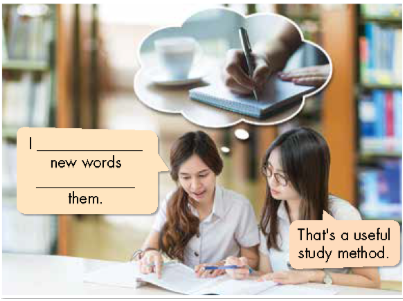
d. Match the actions to the purposes, then write complete sentences.
(Nối hành động với mục đích, sau đó viết các câu hoàn chỉnh.)
|
Actions (Hành động) |
Purposes (Mục đích) |
|
1. I use different study methods (Tôi sử dụng các phương pháp học tập khác nhau) |
understand the actors’ words (hiểu lời diễn viên) |
|
2. He turns subtitles on (Anh ấy bật phụ đề lên) |
read the song’s words (đọc lời bài hát) |
|
3. We note down new words (Chúng tôi ghi lại những từ mới) |
improve all four skills (cải thiện cả bốn kỹ năng) |
|
4. They listen to music with lyrics (Họ nghe nhạc có lời) |
look for mistakes (tìm kiếm sai lầm) |
|
5. She goes over her writing (Cô ấy xem lại bài viết của mình) |
know their meanings (biết ý nghĩa của chúng) |
|
6. I look new words up (Tôi tra từ mới) |
look them up later (tra cứu chúng sau) |
Bài 23 :
e. In pairs: Use the action from Task d. again and make new sentences using your own ideas for the purpose.
(Theo cặp: Sử dụng lại hành động ở Bài tập d và đặt câu mới sử dụng ý tưởng của riêng bạn cho mục đích đó.)
A: I use different study method to improve my writing.
(Tôi sử dụng các phương pháp học tập khác nhau để cải thiện khả năng viết của mình.)
B: We note down new words to use in our writing.
(Chúng tôi ghi lại những từ mới để sử dụng trong bài viết của mình.)
Bài 24 :
2. Underline the correct verb form for each sentence.
(Gạch dưới dạng động từ đúng cho mỗi câu.)
1. I really fancy to wear / wearing this traditional cone hat at our Fashion Show
2. My brother has decided to enter / entering the Back to Our Past Competition.
3. Do you mind to replay / replaying that folk music? It's lovely.
4. My uncle always avoids to tell / telling stories about his past.
5. They plan to do / doing research about life in Hue in the 19th century.
Bài 25 :
3. Complete each sentence with the correct form of a verb from the box.
(Hoàn thành mỗi câu với dạng đúng của động từ trong khung.)
|
make learn give work teach |
1. We want _______ how to make toys from natural materials.
2. Yesterday, we finished _______ on the poster for our Good Old Days project.
3. I have promised _______ my grandfather how to find news online.
4. My grandmother suggested _______ a traditional long dress for the wedding.
5. Our group agreed _______ a presentation about school uniforms in the 20th century.
Bài 26 :
4. Choose the incorrect underlined word or phrase in each sentence.
(Chọn từ hoặc cụm từ gạch chân sai trong mỗi câu.)
1. Just a few years ago, I would never fancy to have a smart TV in my home.
A B C D
2. Tom promised adding some information about the past to his presentation.
A B C D
3. I've decided learning how ethnic minority people use natural materials to dye cloth.
A B C D
4. My children plan researching and make our family tree for the past hundred years.
A B C D
5. Do you mind not to talk about the past in such a negative way?
A B C D
Bài 27 :
4. Make complete sentences from the clues. Make any changes and add more words if necessary.
(Viết câu hoàn chỉnh từ gợi ý. Thực hiện bất kỳ thay đổi nào và thêm nhiều từ hơn nếu cần thiết.)
1. we / plan / visit / historical places / Cao Bang.
2. we / hope / have / bus station / near / village / soon.
3. even / grandmother /enjoy / use / Facebook / communicate / her friends.
4. last year / I / learn / make cakes / watch / cooking videos / Internet.
5. this morning / I / suggest / do a survey / northern women's traditional costumes.
Bài 28 :
a. Read about verbs + to-infinitives, then fill in the blank.
(Đọc về động từ + to nguyên thể, sau đó điền vào chỗ trống.)
Verbs + to-infinitives
We use to-infinitives after some verbs:
• aim: try to achieve something
We aim to provide our audience with the best movie watching experience.
• expect: think something will happen
People expect to see more virtual reality in the future.
• decide: choose something after thinking carefully.
We decided to use the latest innovations.
• hope: wish for something to happen and think it’s possible
They hope to have a better understanding of what their audience likes.
• plan: have something in your mind as a goal
We plan to use virtual reality in all of our games.
• want: wish for something
I want to see more personalized content.
Tạm dịch
Động từ + to-infinitives
Chúng ta dùng to-infinitive sau một số động từ:
• mục tiêu: cố gắng đạt được điều gì đó
Chúng tôi mong muốn mang đến cho khán giả trải nghiệm xem phim tốt nhất.
• mong đợi: nghĩ điều gì đó sẽ xảy ra
Mọi người mong đợi được nhìn thấy nhiều thực tế ảo hơn trong tương lai.
• quyết định: chọn cái gì đó sau khi đã suy nghĩ kỹ.
Chúng tôi quyết định sử dụng những cải tiến mới nhất.
• hy vọng: mong muốn điều gì đó xảy ra và nghĩ rằng điều đó có thể xảy ra
Họ hy vọng sẽ hiểu rõ hơn về những gì khán giả của họ thích.
• kế hoạch: có mục tiêu trong đầu bạn
Chúng tôi dự định sử dụng thực tế ảo trong tất cả các trò chơi của mình.
• muốn: ước một điều gì đó
Tôi muốn xem nhiều nội dung được cá nhân hóa hơn.
People can _______________________ virtual reality TV soon.
Bài 29 :
b. Listen and check. Listen again and repeat.
(Nghe và kiểm tra. Nghe lại và lặp lại.)
Bài 30 :
c. Underline the mistakes in the sentences below and write the correct words on the lines.
(Hãy gạch dưới những lỗi sai trong các câu dưới đây và viết từ đúng vào các dòng.)
1. We expect see more digital media in the future to see
(Chúng tôi hy vọng sẽ thấy nhiều phương tiện truyền thông kỹ thuật số hơn trong tương lai)
2. I want to working as a podcast producer. ___________
3. We want using virtual reality technology in our new movie. ___________
4. She hopes get a job as a movie producer. ___________
5. The company is planning hiring more data scientists. ___________
6. We should aim complete the podcast by next week. ___________
7. You can expect seeing more virtual innovations in the future. ___________
8. She decided to being a game designer. ___________