












|
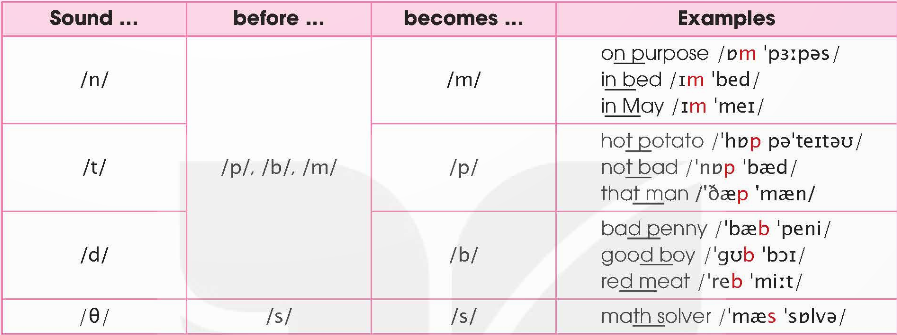
PRONUNCIATION FOCUS ASSIMILATION In English pronunciation, assimilation often occurs in connected speech, where sounds in words can change or blend together based on the sounds that come before or after them. 1 Consonant assimilation: In the word "handbag," the /d/ sound in "hand" is assimilated to the /b/ sound in "bag," so it is pronounced as /hænbæg/. 2. Vowel assimilation: In the phrase "go out," the /aa/ sound in 'go' is assimilated to the /au/ sound in out, so it is pronounced as /gaut/. 3. Nasal assimilation: In the word "handful," the /n/ sound in "hand" is assimilated to the /f/ sound in "ful," so it is pronounced as/hænfl/. |
|
TRỌNG TÂM PHÁT ÂM ĐỒNG HÓA Trong phát âm tiếng Anh, sự đồng hóa thường xảy ra trong lời nói có tính kết nối, trong đó các âm thanh trong từ có thể thay đổi hoặc hòa quyện với nhau dựa trên những âm thanh đi trước hoặc sau chúng. 1 Đồng hóa phụ âm: Trong từ "handbag", âm /d/ trong "hand" được đồng hóa với âm /b/ trong "bag", nên nó được phát âm là /hænbæg/. 2. Đồng hóa nguyên âm: Trong cụm từ “go out”, âm /aa/ trong ‘go’ được đồng hóa với âm /au/ ở ngoài nên được phát âm là /gaut/. 3. Hòa âm mũi: Trong từ “handful”, âm /n/ trong “hand” được đồng hóa với âm /f/ trong “ful”, nên được phát âm là/hænfl/. |






Danh sách bình luận